South Africa September Fuel Prediction 2026: Petrol and Diesel Price Forecast
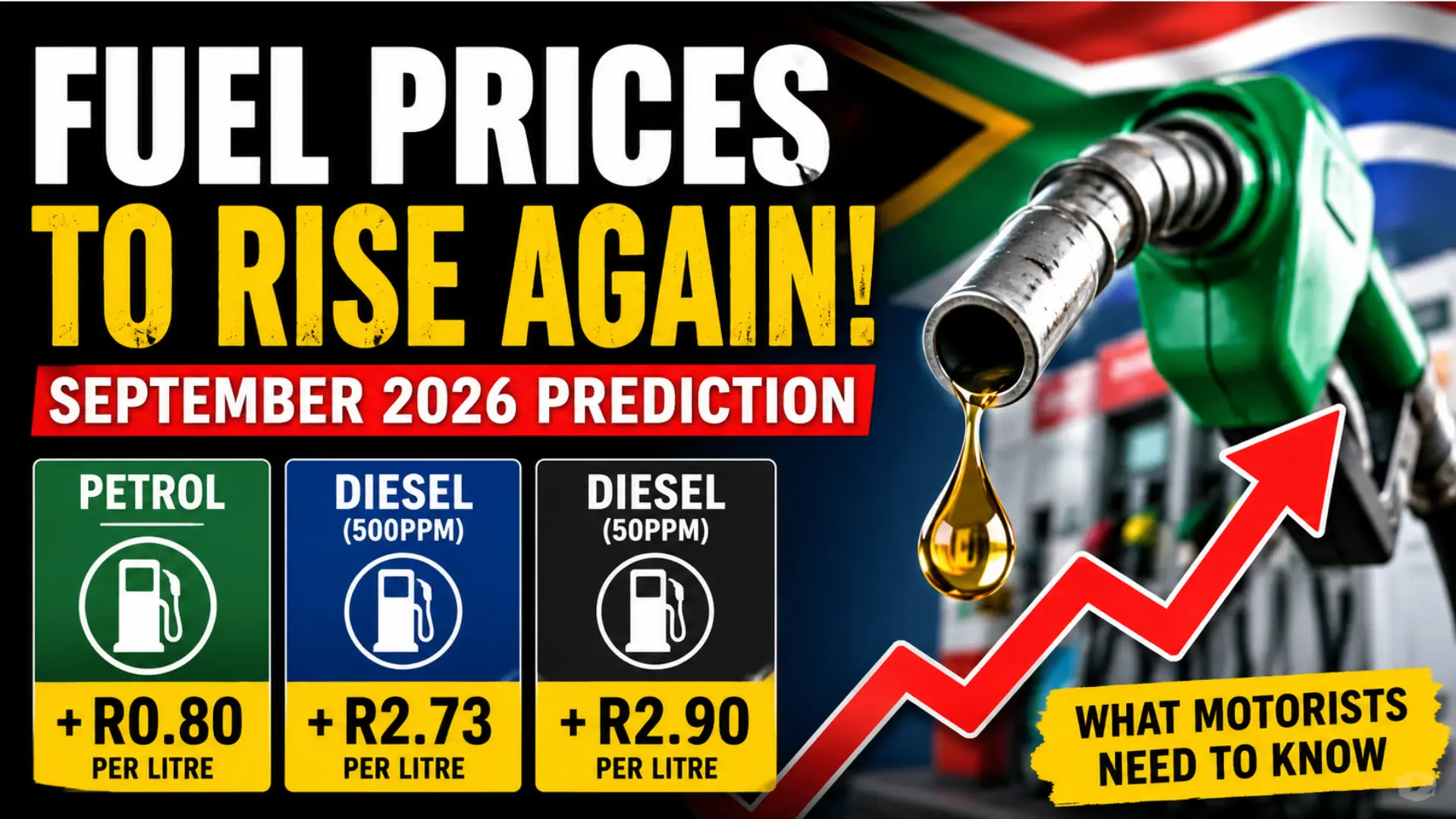
South Africa’s fuel prices could rise sharply again in September 2026, according to the latest Central Energy Fund (CEF) data. The current fuel price outlook points to another difficult month for motorists, with diesel showing the biggest potential increase.
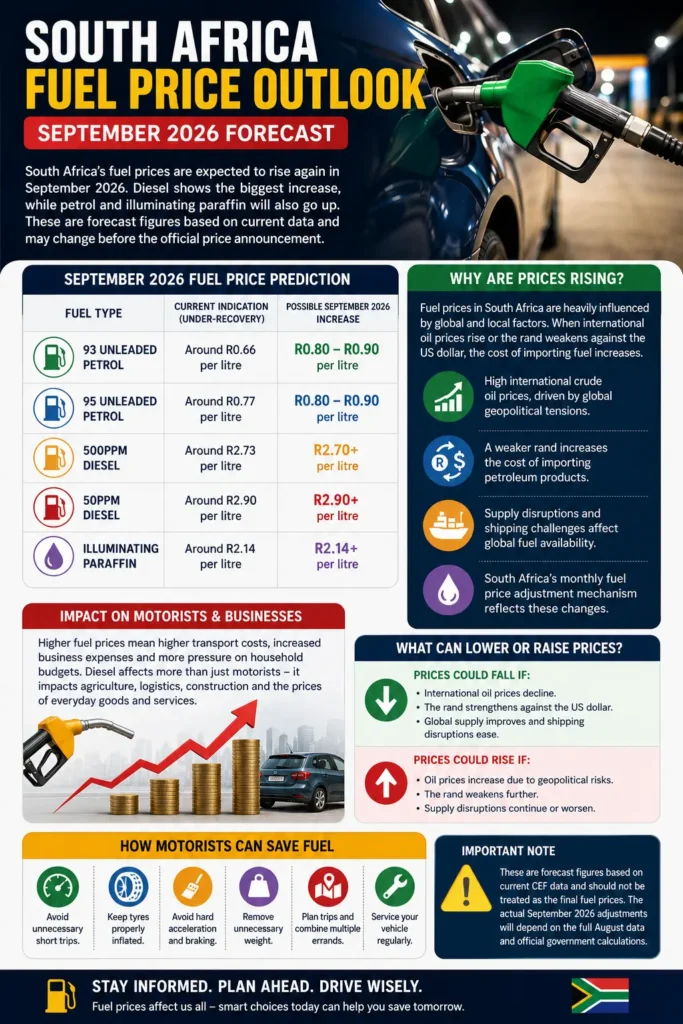
The latest snapshot indicates an under-recovery of about R2.73 per litre for 500ppm diesel and R2.90 for 50ppm diesel. Petrol is also showing an under-recovery, although the expected increase is considerably smaller. If international oil prices and the rand-dollar exchange rate remain at current levels, September could bring another noticeable increase at the pumps.
September 2026 Fuel Price Prediction
The September fuel price forecast is based on current CEF under-recoveries and should not be treated as the final official price announcement. The figures can change significantly before the end of August because South Africa’s monthly fuel price calculation depends on international petroleum prices and the exchange rate.
At the current stage, diesel appears to face the greatest pressure. Petrol prices are also trending higher, while illuminating paraffin could see a substantial increase.
| Fuel type | Current indication | Possible September 2026 increase |
|---|---|---|
| 93 Unleaded petrol | Under-recovery of about R0.66 | Around R0.80–R0.90 |
| 95 Unleaded petrol | Under-recovery of about R0.77 | Around R0.80–R0.90 |
| 500ppm diesel | Under-recovery of about R2.73 | Around R2.70+ |
| 50ppm diesel | Under-recovery of about R2.90 | Around R2.90+ |
| Illuminating paraffin | Under-recovery of about R2.14 | Around R2.14 |
These are forecast figures, not confirmed September prices. The final adjustment will depend on the full month’s data and the government’s fuel price calculation.
You can also read: SASSA September 2026 Grant
Petrol Price Forecast for September 2026
Petrol is currently showing a smaller under-recovery than diesel, but the situation could worsen before the end of August. CEF data currently points to approximately 66 cents per litre for 93 Unleaded and 77 cents for 95 Unleaded.
If international oil markets remain elevated and the rand does not strengthen significantly against the US dollar, the petrol under-recovery could move closer to 80–90 cents per litre. This means motorists should prepare for another increase in both grades of petrol.
93 Unleaded Petrol Prediction
The current indication for 93 Unleaded is an increase of roughly 66 cents per litre. However, this number can change during the remainder of the month as crude oil prices and currency movements are incorporated into the calculation.
A final increase of around 80 cents or potentially higher cannot be ruled out if the current market conditions continue. Drivers who use petrol regularly should therefore budget for a higher fuel bill in September.
95 Unleaded Petrol Prediction
For 95 Unleaded, the current under-recovery is around 77 cents per litre. Based on the current trend, the eventual increase could reach approximately 80–90 cents if market conditions remain unfavorable.
This would put additional pressure on households and businesses, particularly those with long daily commutes. Even an increase of 80 cents per litre can add up quickly for motorists who fill a large tank several times a month.
Diesel Price Forecast for September 2026
Diesel is facing a much more severe increase than petrol. Current CEF data indicates an under-recovery of approximately R2.73 per litre for 500ppm diesel and R2.90 for 50ppm diesel.
Such an increase would have effects beyond private motorists. Diesel is heavily used by trucks, agriculture, construction companies and other commercial operators. Higher diesel costs can therefore increase transportation and operating expenses, which may eventually put additional pressure on prices for goods and services.
500ppm Diesel Prediction
The current forecast indicates a possible increase of around R2.73 per litre for 500ppm diesel. While the final figure is not yet confirmed, this is significantly higher than the expected petrol adjustment.
Businesses that rely on diesel-powered vehicles should pay particular attention to the final August calculation because even a smaller change in the rand-oil combination could materially affect the final September adjustment.
50ppm Diesel Prediction
50ppm diesel is currently showing the largest expected increase, at approximately R2.90 per litre. If the under-recovery remains at a similar level until the end of August, motorists and businesses could face a substantial increase.
The impact could be especially noticeable in the logistics sector because diesel is a major operating cost for heavy vehicles. Increased transport costs can also affect the prices consumers pay for products transported across the country.
Why Are South Africa’s Fuel Prices Rising?
South Africa’s fuel prices are strongly influenced by international oil prices and the rand’s exchange rate against the US dollar. When crude oil becomes more expensive in dollar terms, or when the rand weakens, the local cost of importing petroleum products generally increases.
The oil market has been particularly volatile in 2026 because of geopolitical tensions in the Middle East. Disruptions around the Strait of Hormuz have raised concerns about global oil supply, keeping crude prices significantly above levels seen before the conflict.
Several factors are therefore important for the September fuel price calculation:
- International Brent crude oil prices
- The rand-to-US-dollar exchange rate
- Global petroleum product prices
- Supply disruptions and geopolitical tensions
- Changes in international shipping and oil flows
- South Africa’s monthly fuel price adjustment mechanism
You can also read: SRD SASSA Gov Za SC19 Status Check Online
Impact of the Middle East Conflict on Oil Prices
International oil markets have experienced significant volatility since the US-Israeli conflict with Iran began in late February. The Strait of Hormuz has been a major concern because it is an important route for global oil shipments.
Although Brent crude has recently traded mostly around the $90-per-barrel level, prices remain considerably higher than the approximately $70 level seen before the conflict. Earlier in the year, Brent climbed to around $126 per barrel.
The situation means that any improvement in oil supply could push prices lower, while further disruptions could quickly send them higher. This uncertainty makes the final September fuel price prediction difficult to determine this early in the month.
South Africa Fuel Price Changes in 2026
Fuel prices have already moved considerably during 2026. The price of 95 Unleaded increased from R19.47 per litre in March to R24.71 in August, after reaching a much higher level of R27.19 in June.
Diesel has experienced even greater volatility. Its wholesale price increased from around R17.70 in March to R25.30 in August, while it reached approximately R30.30 in May.
This shows why motorists should not rely on a single CEF snapshot when estimating the final September price. The under-recovery can move substantially during the month.
What Happened to Fuel Prices in August?
At the beginning of August, both grades of petrol became cheaper by 52 cents per litre. Diesel moved in the opposite direction, increasing by between R1.23 and R1.38 per litre, depending on the grade.
The contrasting changes demonstrate the different market pressures affecting petrol and diesel. While petrol received some relief in August, diesel remained under considerable pressure.
September could therefore bring another difficult adjustment, particularly for diesel users.
Will September Fuel Prices Increase Further?
Based on the latest CEF indication, an increase is currently more likely than a decrease. Petrol could rise by around 80–90 cents per litre, while diesel could face increases close to R2.70–R2.90 if current conditions persist.
However, these numbers should be considered provisional. A stronger rand or a meaningful decline in international oil prices could reduce the final increase, while higher crude prices or a weaker rand could push the adjustment even higher.
What Could Lower the September Fuel Increase?
There are several developments that could improve South Africa’s fuel price outlook before the end of August. A sustained decline in Brent crude prices would reduce the international cost component used in the calculation.
A stronger rand would also help because petroleum products are priced internationally in US dollars. If both oil prices and the exchange rate move favorably, the final September increase could be smaller than the current CEF snapshot suggests.
What Could Make Fuel Prices Even Higher?
The biggest risks are further disruptions to global oil supply and a sharp increase in crude oil prices. Any prolonged disruption around the Strait of Hormuz could increase market fears and place additional pressure on petroleum prices.
A weaker rand could make the situation worse. Even if international oil prices remain stable, a significant depreciation of the local currency can increase the cost of imported petroleum products.
Expert Outlook for Oil Prices
There are also signs that international oil prices could gradually soften. JPMorgan has projected average Brent prices of around $86 per barrel in the third quarter of 2026, falling to about $80 in the fourth quarter and approximately $78 in 2027.
Such a trend would eventually provide some relief to fuel consumers. However, the timing matters. South African motorists still face the September calculation based on conditions during August, meaning longer-term oil forecasts may not immediately translate into lower pump prices.
How Motorists Can Prepare for a Fuel Price Increase
Drivers can reduce the financial impact of higher fuel prices by paying attention to fuel consumption rather than focusing only on the pump price. Small changes in driving habits can make a noticeable difference over a month.
Useful steps include:
- Avoid unnecessary short trips.
- Keep tyres properly inflated.
- Avoid excessive acceleration and hard braking.
- Remove unnecessary weight from the vehicle.
- Compare fuel prices at nearby stations.
- Plan trips to combine multiple errands.
- Maintain the vehicle according to the manufacturer’s schedule.
These measures will not prevent a fuel price increase, but they can reduce the number of litres a vehicle consumes.
You can also read: SARS Digital VAT System Changes
Common Mistakes When Reading CEF Fuel Predictions
One of the biggest mistakes is treating the latest CEF under-recovery as the confirmed pump price. It is only an indication of where prices could move based on data available at that point in the month.
Another mistake is assuming that crude oil prices alone determine South African fuel prices. The rand-dollar exchange rate is also extremely important, so a fall in oil prices does not automatically guarantee cheaper fuel at South African filling stations.
September 2026 Fuel Price Forecast: What to Expect
The current outlook suggests that September 2026 could bring another significant fuel price increase in South Africa, with diesel facing the strongest pressure. The latest indication points to around R2.73 for 500ppm diesel and R2.90 for 50ppm diesel.
For petrol, the expected increase is currently smaller, with 93 Unleaded showing an under-recovery of about 66 cents and 95 Unleaded about 77 cents. If the trend continues through the end of August, petrol increases of approximately 80–90 cents per litre are possible.
The final September 2026 fuel prices will only become clear after the full monthly calculation is completed. Until then, motorists should treat current CEF figures as a forecast rather than a confirmed price announcement.
Frequently Asked Questions
What is the September 2026 petrol price prediction in South Africa?
Current CEF data suggests petrol could increase by around 80–90 cents per litre if current trends continue. The final increase may be different because the calculation continues throughout August.
How much could diesel increase in September 2026?
The latest indication points to approximately R2.73 per litre for 500ppm diesel and R2.90 for 50ppm diesel. These figures are provisional and can change before the official adjustment.
Why is diesel expected to increase more than petrol?
Diesel is currently showing a much larger under-recovery in the CEF data. International petroleum prices, supply conditions and currency movements are contributing to the pressure.
Is the September 2026 fuel price confirmed?
No. The current figures are predictions based on CEF data. The final fuel prices will be determined after the complete monthly calculation.
Could September fuel prices be lower than predicted?
Yes. A significant decline in international oil prices or a stronger rand could reduce the final increase. Conversely, worsening market conditions could push prices higher.
When will the final September 2026 fuel prices be known?
The final adjustment is determined after the August data has been completed and the relevant calculations have been finalized. Until then, CEF snapshots provide an indication rather than a confirmed price.
What is the biggest factor affecting South Africa’s fuel prices?
International petroleum prices and the rand-dollar exchange rate are among the most important factors. Geopolitical events can also have a major impact by changing global oil supply expectations.