South Africa Fuel Price Decrease June 2026
South African motorists could soon benefit from one of the biggest fuel price reductions of 2026. Early projections from the Central Energy Fund (CEF) indicate that both petrol and diesel prices are likely to decrease significantly in July 2026, providing much-needed relief after months of high fuel costs.
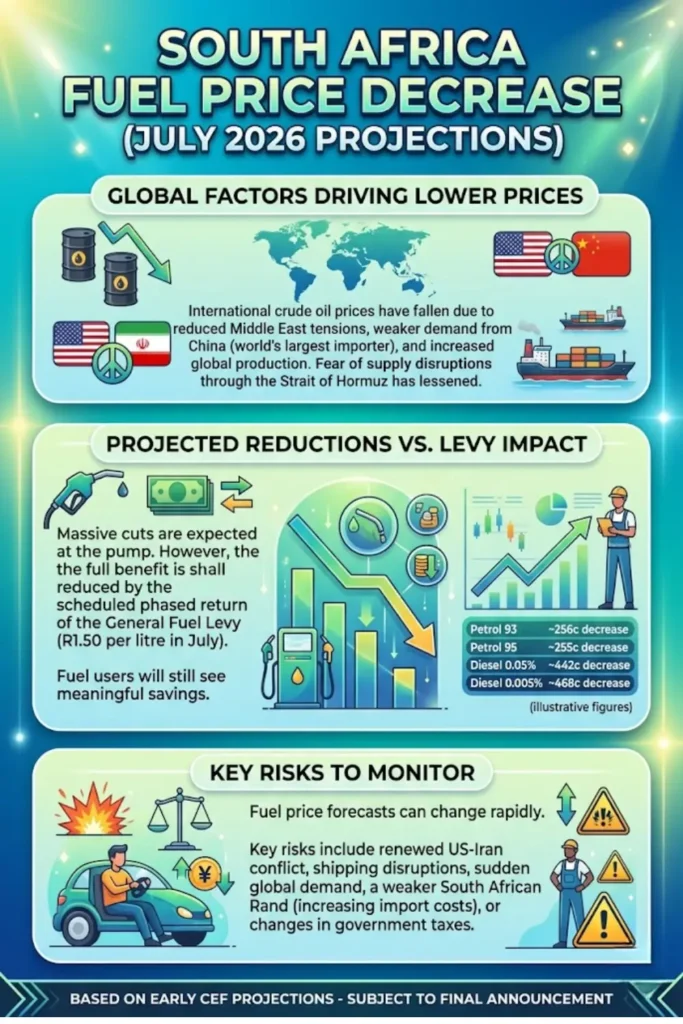
The expected reductions come after global oil prices declined sharply due to improving geopolitical conditions in the Middle East, lower oil demand from China, and increased production from major oil-producing countries. While final fuel prices have not yet been confirmed, current projections suggest that motorists may see meaningful savings at the pumps.
Why Fuel Prices Are Expected to Drop
Several global and local factors are contributing to the anticipated fuel price decrease.
The most important factor is the decline in international crude oil prices. Since mid-May 2026, oil prices have fallen as tensions between the United States and Iran eased, reducing fears of major supply disruptions. At the same time, weaker demand from China and increased global oil production have added further downward pressure on prices.
You can also read: Sassa July Grant Payment Dates 2026
South Africa also benefits when the rand performs well against the US dollar because fuel imports are priced in dollars. Recent positive economic developments have helped support the rand, reducing some of the pressure on local fuel costs.
Projected Fuel Price Changes for July 2026
According to the latest CEF projections, motorists could see the following fuel price adjustments:
| Fuel Type | Expected Change |
|---|---|
| Petrol 93 | Decrease of 256 cents per litre |
| Petrol 95 | Decrease of 255 cents per litre |
| Diesel 0.05% | Decrease of 442 cents per litre |
| Diesel 0.005% | Decrease of 468 cents per litre |
These figures are based on current oil prices and exchange rates and may change before the official announcement.
Diesel users are expected to receive the biggest benefit, with reductions potentially exceeding R4 per litre.
Impact of the General Fuel Levy
Although the projected decreases look substantial, motorists should understand that the final reductions may be smaller due to the phased return of the General Fuel Levy (GFL).
The government previously provided temporary fuel tax relief, but that support is now being removed in stages. In June 2026, R1.50 per litre of the levy was reintroduced. Another R1.50 per litre is expected to return in July, reducing the size of the final fuel price cuts.
How the Levy Affects Fuel Prices
- The full projected decrease may not reach consumers.
- An additional R1.50 levy will offset part of the expected reductions.
- Petrol price cuts are likely to be smaller than current estimates.
- Diesel users will still benefit from significant reductions despite the levy increase.
Motorists should therefore view current projections as preliminary estimates rather than guaranteed savings.
You can also read: Will Bafana Bafana Shock
Global Oil Market Trends Driving Lower Prices
The international oil market remains the biggest influence on South African fuel prices.
Recent data shows that oil prices have dropped nearly 10% over the past month. Improved oil flows through the Strait of Hormuz have reduced fears of supply shortages, while weaker demand from China has created additional downward pressure on prices.
China, the world’s largest oil importer, has reported some of its lowest import levels in years. This slowdown in demand has helped push global oil prices lower, creating favorable conditions for fuel-importing countries such as South Africa.
Risks That Could Affect Final Fuel Prices
While current projections are positive, several risks could still influence the final fuel price announcement.
Geopolitical tensions remain a concern. Any renewed military conflict involving Iran or disruptions in key shipping routes could quickly drive oil prices higher. Currency fluctuations also remain important, as a weaker rand would increase fuel import costs.
Key risks include:
- Renewed conflict between the United States and Iran.
- Disruptions in the Strait of Hormuz.
- Unexpected increases in global oil demand.
- Significant weakening of the South African rand.
- Changes in government fuel taxes or levies.
Motorists should monitor developments throughout the month because fuel price forecasts can change significantly before official adjustments are implemented.
How the Rand Is Supporting Lower Fuel Prices
The South African rand has remained relatively stable against the US dollar despite global economic uncertainty.
Investor confidence improved after positive fiscal developments, including a stronger primary budget surplus and a credit rating upgrade from Fitch. These developments have helped strengthen South Africa’s financial outlook and provided support for the local currency.
A stronger rand reduces the cost of importing fuel, which contributes directly to lower pump prices for consumers.
What the Fuel Price Decrease Means for South Africans
Lower fuel prices provide benefits that extend beyond motorists. Transport companies, logistics businesses, farmers, and delivery services all rely heavily on fuel.
Potential benefits include:
- Reduced transport costs.
- Lower delivery expenses for businesses.
- Possible relief on food prices.
- Reduced operating costs for farmers.
- More disposable income for households.
While lower fuel prices do not immediately reduce inflation, they often help ease cost pressures across multiple sectors of the economy over time.
Tips for Motorists Before the Fuel Price Change
Drivers can take a few practical steps to maximize potential savings once the new prices take effect.
- Delay non-essential fuel purchases if possible.
- Compare prices and promotions at different stations.
- Maintain correct tyre pressure to improve fuel efficiency.
- Avoid unnecessary idling and aggressive driving.
- Plan trips efficiently to reduce fuel consumption.
These simple habits can help motorists save even more, regardless of future fuel price movements.
You can also read: SARS 2026 Tax Filing Dates
Final Thoughts
The projected South Africa fuel price decrease for June 2026 and the expected implementation in July offer encouraging news for motorists facing record-high fuel costs. Falling global oil prices, lower Chinese demand, increased oil production, and a relatively stable rand have all contributed to the anticipated reductions.
Although the reintroduction of the General Fuel Levy will reduce the size of the final cuts, South Africans can still expect meaningful relief at the pumps. As global market conditions continue to evolve, motorists should watch for the official fuel price announcement to confirm the exact reductions that will take effect.