SASSA Grant Review AI Data Matching & Repayment Terms: What Beneficiaries Need to Know in 2026
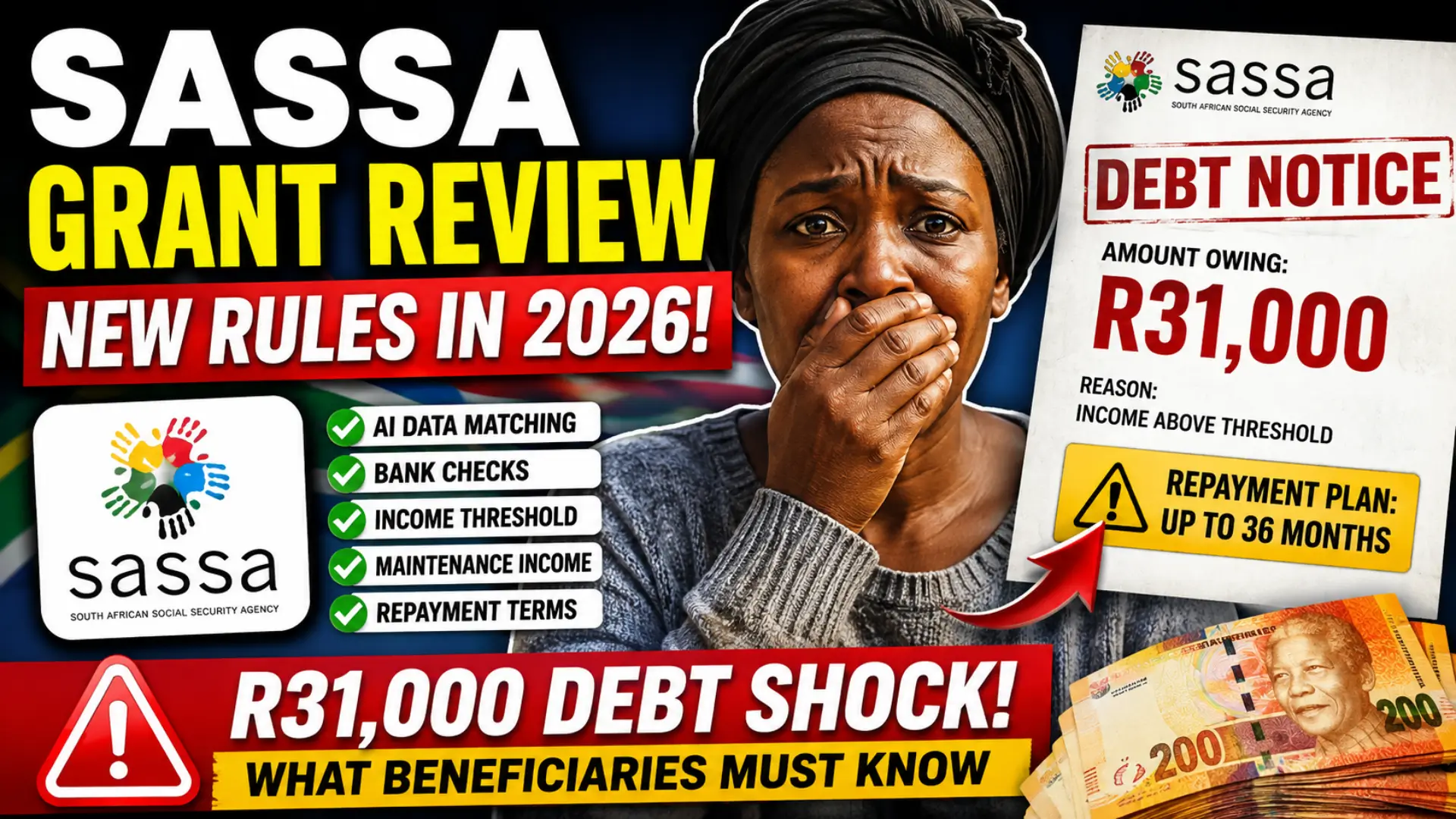
SASSA is increasing its use of automated data matching to identify beneficiaries whose financial circumstances may no longer meet the requirements for a social grant. Bank information, credit records and information from other government systems can be compared with beneficiary records, allowing potential eligibility problems to be flagged for review.
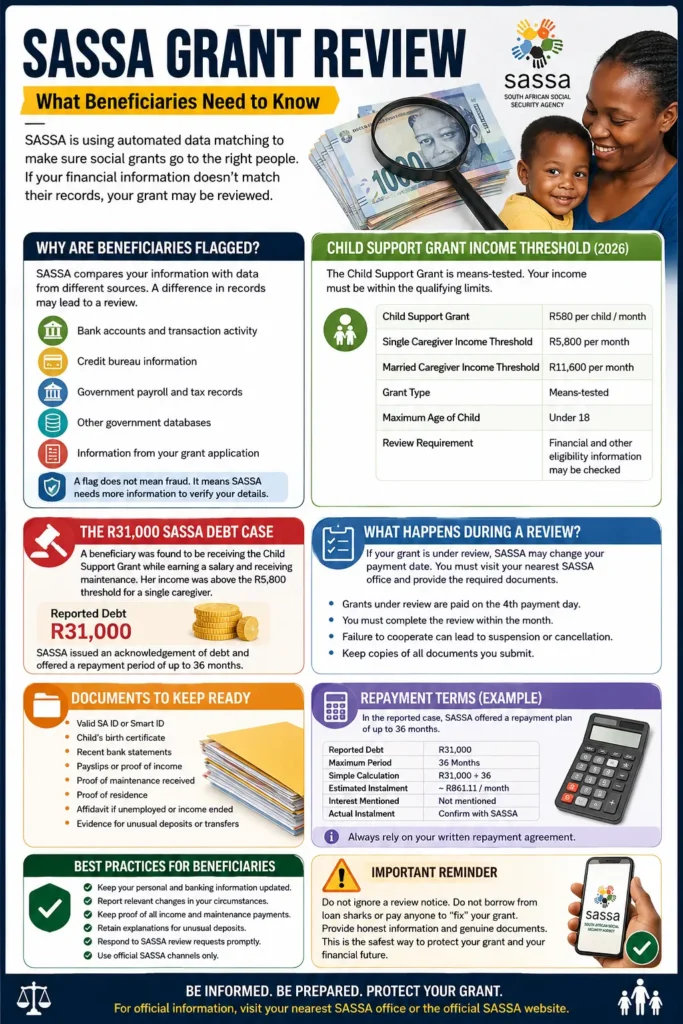
A recent case involving a Child Support Grant beneficiary who received a R31,000 debt notice has highlighted what can happen when SASSA determines that a beneficiary received grant payments while their income was above the applicable threshold. The case also raises important questions about repayment arrangements, maintenance income, bank deposits and the wider financial consequences of a SASSA grant review.
SASSA Grant Review: Why Beneficiaries Are Being Flagged
A SASSA grant review is designed to check whether a beneficiary still meets the conditions for receiving financial assistance. The agency uses a means test for grants such as the Child Support Grant, which considers the applicant’s financial circumstances. SASSA’s own information explains that a review can be triggered by changes in circumstances, the outcome of an eligibility assessment or information suggesting that the beneficiary no longer qualifies.
You can also read: NSFAS 2027 Application Guide
The process is becoming increasingly data-driven. According to National Treasury figures reported in 2026, SASSA had checked approximately 6 million bank accounts and 8 million credit bureau records by December 2025. Those checks resulted in more than 291,000 beneficiaries being flagged for review, while 34,661 grants were cancelled. By July 2026, the Department of Social Development said the number of grants flagged for review during the 2025/26 period had risen to about 420,000.
What Does AI Data Matching Mean for SASSA Beneficiaries?
In simple terms, automated data matching allows SASSA to compare information held by different institutions instead of relying only on information supplied when a person originally applied for a grant. The system can identify financial information that appears inconsistent with a beneficiary’s declared circumstances.
Possible information sources can include:
- Bank-account information and transaction activity
- Credit bureau information
- Government payroll records
- Tax-related information
- Other government databases
- Information supplied during a grant application or review
A flag does not automatically mean fraud. It means SASSA has identified information that may require verification. Beneficiaries should therefore respond to a review request and provide documents that explain their circumstances rather than assuming that a flag automatically means their grant has been permanently cancelled.
SASSA Child Support Grant Income Threshold in 2026
The Child Support Grant is means-tested, meaning the caregiver’s financial circumstances must remain within the qualifying limits. For 2026, the Child Support Grant is R580 per month per child, while the reported monthly income threshold is R5,800 for a single caregiver and R11,600 for a married caregiver. These figures are also reflected in grant statistics compiled by the University of Cape Town’s Children Count project from SASSA data.
This is important because beneficiaries sometimes assume that receiving a salary automatically ends a grant or that a small additional payment will never matter. The real issue is whether the income and circumstances used in the means test remain within the applicable qualifying requirements. Beneficiaries should report relevant changes and keep evidence showing where money entering their account came from.
| 2026 Child Support Grant information | Amount / requirement |
|---|---|
| Child Support Grant | R580 per month |
| Single caregiver income threshold | R5,800 per month |
| Married caregiver income threshold | R11,600 per month |
| Grant type | Means-tested |
| Maximum age of child | Under 18 |
| Review requirement | Financial and other eligibility information may be checked |
The figures above reflect 2026 information available from government and SASSA-linked sources. Beneficiaries should confirm their individual circumstances directly with SASSA because eligibility can depend on household and marital circumstances as well as income.
The R31,000 SASSA Debt Case Explained
A case reported on 24 August 2026 involved a Child Support Grant beneficiary identified as Sithembile P. According to The South African, SASSA’s review found that she had been receiving the R580 Child Support Grant while receiving approximately R4,800 in salary and R2,000 in maintenance payments, producing reported monthly income of R6,800. That was above the reported R5,800 threshold for a single caregiver.
You can also read: NSFAS Status Check 2026You can also read:
The report says the situation had allegedly continued for more than five years. When the beneficiary later attended a SASSA office in Tembisa, she was issued an acknowledgement of debt for R31,000. The case is particularly important because it shows that an eligibility review can potentially result not only in a grant being stopped or changed, but also in SASSA seeking repayment of amounts it considers to have been paid when the beneficiary was not eligible.
Why Maintenance Payments Can Matter
Maintenance paid by a child’s other parent can be relevant when SASSA assesses a Child Support Grant applicant’s financial circumstances. SASSA’s official guidance specifically asks applicants to provide proof of maintenance received for the child, alongside proof of earnings.
That means caregivers should not assume that maintenance payments are automatically ignored simply because the money is intended for the child’s needs. The correct treatment depends on SASSA’s applicable means-test rules and the beneficiary’s circumstances, so anyone receiving maintenance should keep clear documentation of the payments and disclose information when required.
Can One Bank Deposit Trigger a SASSA Review?
Reports about the current verification system have warned that unusual or higher-than-expected deposits can lead to a beneficiary being flagged. The South African reported that even a single bank deposit above the applicable threshold could trigger a review.
However, beneficiaries should understand an important distinction: a bank deposit is not automatically proof of employment income or fraud. A payment could potentially be a legitimate transfer, refund, family contribution or another transaction that needs to be explained. This is why keeping bank records and supporting documents is so important. If SASSA asks you to explain a transaction, provide evidence showing exactly what the money was and where it came from.
What Happens During a SASSA Grant Review?
A review generally gives SASSA an opportunity to verify whether the beneficiary continues to satisfy the relevant requirements. Beneficiaries whose grants are under review may experience a different payment timetable. In July 2026, SASSA announced that grants under review would be paid on the fourth payment day, rather than the normal three-day cycle, while beneficiaries were instructed to visit their nearest SASSA office during the month to complete the review.
Beneficiaries should take the review seriously. SASSA has specifically advised people under review to provide documents such as identification, proof of income, recent bank statements and proof of residence, depending on their circumstances. Failure to cooperate with a review can result in a grant being suspended or lapsing.
Documents to Keep Ready
If you receive a SASSA review request, preparing your documents before visiting an office can make the process easier.
- Valid South African ID or Smart ID
- Child’s birth certificate or relevant child documentation
- Recent bank statements
- Payslips or proof of employment income
- Proof of maintenance received
- Proof of residence
- An affidavit or supporting documents if you are unemployed or a source of income has ended
- Evidence explaining unusual deposits or transfers
Do not alter, hide or manipulate bank records. If a transaction is legitimate, the safest approach is to provide genuine evidence explaining it.
What Happens If SASSA Says You Were Overpaid?
If SASSA concludes that a beneficiary received money despite no longer meeting the eligibility requirements, the agency may seek repayment of the amount it considers to have been incorrectly paid. The R31,000 case reported in August 2026 demonstrates how a review can develop into a formal acknowledgement-of-debt process.
An acknowledgement of debt is different from simply receiving a review notification. It confirms an amount that SASSA says is owed and establishes repayment arrangements. Beneficiaries should read such documentation carefully and ask SASSA to explain how the amount was calculated if they do not understand or dispute it.
SASSA Repayment Terms for the R31,000 Debt
According to the reported R31,000 case, SASSA offered a structured repayment arrangement of up to 36 months. The documentation described in the report did not mention interest being added to the instalments. The precise terms, however, depend on the actual acknowledgement-of-debt document issued to the beneficiary.
You can also read: SASSA Status on Moya App Step by Step
If the full R31,000 were divided evenly across 36 months, the simple mathematical amount would be approximately R861.11 per month. That calculation is only an illustration; beneficiaries should not assume that their actual SASSA instalment will be exactly this amount because the repayment agreement may contain specific terms.
| Example repayment calculation | Amount |
| Reported debt | R31,000 |
| Maximum reported period | 36 months |
| Simple division of R31,000 ÷ 36 | About R861.11/month |
| Interest reported in the case documentation | Not mentioned |
| Actual instalment | Confirm with SASSA |
The most important point is to rely on the written repayment agreement rather than calculations circulating online.
Wider Consequences for SASSA Beneficiaries
A grant review can create financial pressure even when a beneficiary did not deliberately provide false information. A person may suddenly have to explain transactions, attend a SASSA office, deal with a possible suspension and, in some circumstances, respond to a repayment demand.
The consequences can become more serious when people try to solve a SASSA debt through expensive informal borrowing. Civil-society organisation Black Sash has documented concerns involving beneficiaries borrowing against future grant payments, potentially exposing already vulnerable households to high interest and fees.
Why Taking a Loan to Pay SASSA Can Be Risky
Using expensive credit to settle a grant-related debt can turn one financial problem into a larger one. A beneficiary should first understand the official repayment arrangement and determine whether there is a legitimate way to challenge or clarify the debt.
Avoid:
- Loan sharks or informal lenders
- Anyone promising to “remove” a SASSA debt for a fee
- Giving another person your SASSA PIN or banking credentials
- Paying someone to perform a free official SASSA status check
- Signing documents you do not understand
- Ignoring a formal review or debt notice
A legitimate SASSA issue should be handled through official channels and supported by genuine documentation.
What to Do If You Receive a SASSA Review Notice
The best response is to treat the notification as a request for verification rather than immediately assuming that your grant has been cancelled. SASSA’s July 2026 guidance says beneficiaries whose grants are under review should complete the review and provide the documents needed to verify continued eligibility.
Start by checking whether your income, marital status, bank details, residence or other circumstances have changed since you originally applied. Then collect documents that support your explanation. If an amount appearing in your bank account was not income, keep evidence that establishes its real source.
A Simple SASSA Review Checklist
- Confirm the review notice and understand what SASSA is asking you to verify.
- Collect recent bank statements for the relevant accounts.
- Prepare proof of income, including payslips or an affidavit where appropriate.
- Document maintenance payments received for the child.
- Explain unusual deposits with receipts, transfer records or other evidence.
- Attend the SASSA review within the required period.
- Ask for clarification if SASSA says you owe money.
- Keep copies of documents and any acknowledgement or repayment agreement you sign.
Responding early is generally safer than allowing a review request to remain unresolved.
What If the SASSA Review Decision Is Wrong?
Automated systems can identify information that needs checking, but a flag itself should not be treated as a final finding of fraud. If your financial information has been misunderstood, gather evidence that explains the discrepancy and present it during the review.
For example, if a large deposit was a refund, a transfer between your own accounts, a once-off family payment or another transaction that does not represent regular earnings, documentation can help establish the circumstances. The key is to provide truthful evidence rather than simply arguing that the deposit should not count.
How Beneficiaries Can Avoid Future Problems
The safest approach is to keep SASSA’s records consistent with your real circumstances. If your income changes, your marital status changes or another important eligibility factor changes, do not assume that SASSA will never discover the change simply because you do not report it.
You can also read: E Life Certification Self Service Portal South Africa
Good record-keeping is equally important. Keep payslips, maintenance records, bank statements and other financial documents so you can explain transactions if your grant is reviewed months or years later.
Best Practices for SASSA Beneficiaries
- Keep your personal and banking information updated.
- Report relevant changes in financial circumstances.
- Keep proof of all regular income.
- Keep records of maintenance received for children.
- Retain explanations for unusual bank deposits.
- Respond to SASSA review requests promptly.
- Read an acknowledgement of debt before signing it.
- Request clarification of any amount you believe is incorrect.
- Use official SASSA channels instead of unofficial “agents”.
- Never pay a third party to guarantee that a grant review will be cleared.
These steps do not guarantee that a beneficiary will never be reviewed, but they can make it much easier to demonstrate that legitimate transactions and changes in circumstances have been properly documented.
Latest SASSA Grant Review Update for August 2026
The scale of SASSA’s verification programme shows that grant reviews are becoming a continuing part of social-assistance administration rather than an occasional manual exercise. National Treasury reported hundreds of thousands of beneficiaries being flagged, while the Department of Social Development later indicated that approximately 420,000 grants had been flagged for review during the 2025/26 period.
SASSA has also confirmed that beneficiaries whose grants are under review can have a different payment date and must complete the required verification process. This makes it especially important for beneficiaries not to ignore review notifications simply because a payment has temporarily arrived.
Conclusion
The reported R31,000 SASSA debt case is a warning that beneficiaries should take changes in income and grant eligibility seriously. Modern data matching allows SASSA to identify financial information that may not have been visible during an earlier application or review, and this can lead to further verification or a repayment demand where SASSA determines that payments were made incorrectly.
You can also read: Sassa E-Life Certification Portal Online
At the same time, being flagged does not automatically mean that someone committed fraud. A beneficiary should have an opportunity to provide relevant information and supporting documents. If you receive a review notice or acknowledgement of debt, respond through official SASSA channels, keep evidence of your financial circumstances and carefully check how any alleged debt was calculated before agreeing to repayment terms.