How to Check Fuel Recovery South Africa August 2026
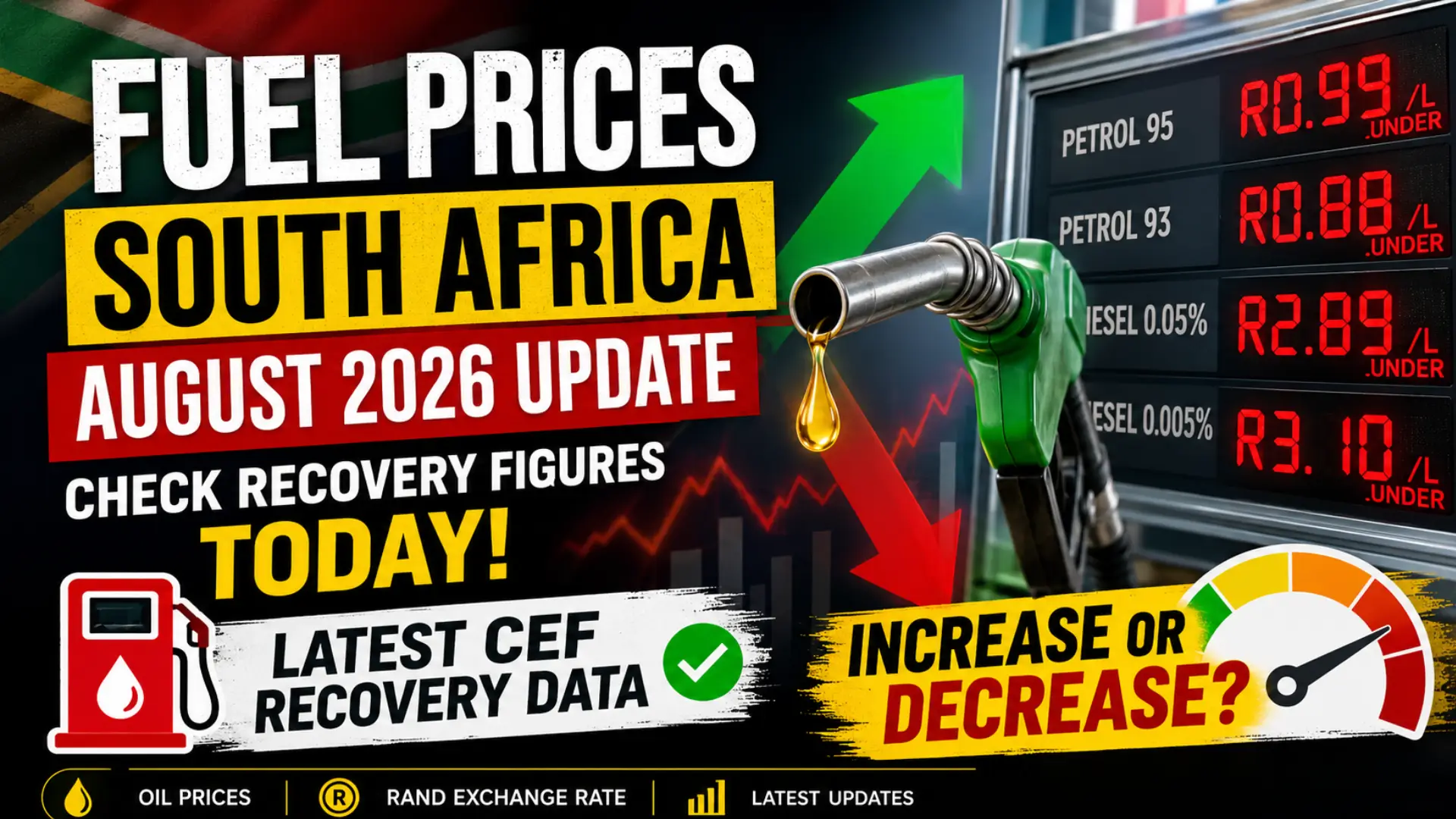
South African motorists can use the Central Energy Fund (CEF) fuel recovery data to track whether petrol and diesel prices are currently heading towards an increase or decrease. For August 2026, this daily data has become particularly important because international oil prices, geopolitical tensions and the rand-dollar exchange rate have caused fuel-price expectations to change rapidly.
The latest August 2026 figures show that petrol recoveries have moved sharply in the wrong direction. Petrol 95 is currently showing an under-recovery of about R0.99 per litre, while Petrol 93 is at about R0.88 per litre. This means motorists should understand how to check CEF recovery figures instead of relying only on early-month predictions.
What Is Fuel Recovery in South Africa?
Fuel recovery is an estimate showing the difference between the regulated fuel price and the amount that current market conditions suggest should be charged. The calculation is influenced mainly by international petroleum prices and the rand’s exchange rate against the US dollar. The CEF publishes daily information that helps indicate whether the next monthly adjustment could be higher or lower.
You can also read: SRD Sassa E-life Certification Portal Details
An over-recovery generally points towards a potential fuel-price decrease, while an under-recovery indicates upward pressure on the next adjustment. However, a recovery figure is not the final pump-price decision. The official monthly adjustment is determined through the country’s regulated fuel-pricing process. The Department of Mineral and Petroleum Resources confirms that fuel prices are adjusted monthly using factors including international oil prices, exchange rates and statutory levies.
How to Check Fuel Recovery South Africa in August 2026
The simplest method is to use the official fuel-price information provided through the Department of Mineral and Petroleum Resources and the Central Energy Fund. Look for the latest daily recovery or fuel-price snapshot rather than an old article because the figures can change from one day to another.
Follow these steps:
- Open the official Department of Mineral and Petroleum Resources fuel-price information page.
- Look for the latest CEF-related fuel-price or recovery information.
- Check the figures for Petrol 93, Petrol 95 and diesel.
- Compare the current recovery with the beginning-of-month and mid-month figures.
- Check the date of the data because fuel recoveries are constantly changing.
- Remember that the recovery is a projection, not the final regulated pump price.
The official government page confirms that the department publishes fuel-price adjustments and related updates through the CEF.
August 2026 Fuel Recovery Latest Update
The August recovery picture has changed significantly during the month. Petrol initially started August with an under-recovery of roughly R1 per litre, but improved to around 50–65 cents per litre at one stage. Rising international oil prices then reversed much of that improvement.
The latest figures reported from CEF data show Petrol 95 at an under-recovery of R0.99 per litre and Petrol 93 at R0.88 per litre. This puts petrol almost back at the position seen at the beginning of August.
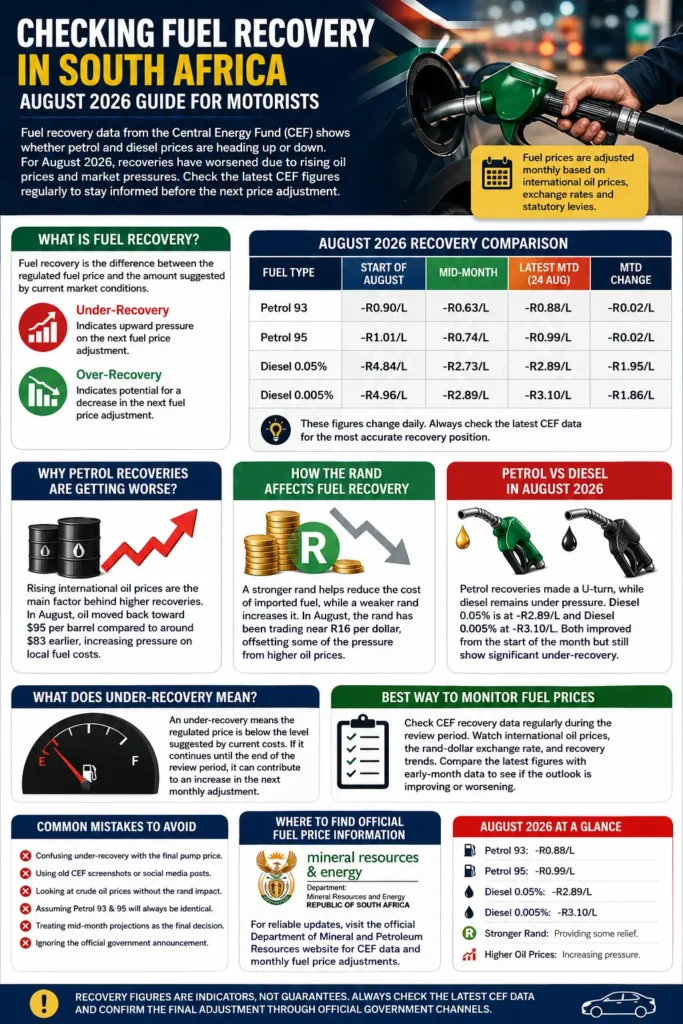
August 2026 Recovery Comparison
| Fuel | Start of August | Mid-month | Latest MTD | MTD Change |
|---|---|---|---|---|
| Petrol 93 | -R0.90/L | -R0.63/L | -R0.88/L | -R0.02/L |
| Petrol 95 | -R1.01/L | -R0.74/L | -R0.99/L | -R0.02/L |
| Diesel 0.05% | -R4.84/L | -R2.73/L | -R2.89/L | -R1.95/L |
| Diesel 0.005% | -R4.96/L | -R2.89/L | -R3.10/L | -R1.86/L |
These figures illustrate why motorists should check the latest recovery data rather than assuming that an early-month projection will remain unchanged.
Why Are Petrol Recoveries Getting Worse?
The biggest factor is the movement in international oil prices. When crude oil becomes more expensive, South Africa’s import-related fuel costs increase, putting upward pressure on local fuel prices. Renewed geopolitical tensions have therefore played an important role in the deterioration of the August recovery position.
The latest reporting indicates that oil prices moved back towards roughly $95 per barrel, compared with about $83 per barrel earlier in August. That reversal erased much of the improvement motorists had seen in the recovery figures.
How the Rand Affects Fuel Recovery
The rand-dollar exchange rate is another important part of the calculation. Because international crude oil is priced in US dollars, a stronger rand can reduce the local cost of imported petroleum products, while a weaker rand can increase it.
You can also read: SASSA Status on Moya App Step by Step
The stronger rand has provided some relief during August. According to the latest reporting, the rand has been trading close to the R16-per-dollar level, helping offset some of the pressure created by higher oil prices. This is why checking only the Brent crude price does not give motorists the complete fuel-price picture.
Petrol vs Diesel Recovery in August 2026
Petrol and diesel have not followed exactly the same recovery pattern. Petrol recoveries have effectively made a U-turn, while diesel remains under significant pressure even though its position is better than it was at the beginning of the month.
The latest CEF figures put diesel under-recoveries at approximately R2.89 per litre for 0.05% diesel and R3.10 per litre for 0.005% diesel. These numbers demonstrate that diesel users should also monitor the daily recovery figures closely.
What the August figures mean
- Petrol 93: Around R0.88/L under-recovery.
- Petrol 95: Around R0.99/L under-recovery.
- Diesel 0.05%: Around R2.89/L under-recovery.
- Diesel 0.005%: Around R3.10/L under-recovery.
- Stronger rand: Providing some offset against higher oil prices.
- Higher crude prices: Increasing pressure on local fuel costs.
These figures are indicators of the direction of the fuel-price calculation and should not be treated as guaranteed future pump prices.
What Does an Under-Recovery Mean for Motorists?
An under-recovery means that, based on the monitored market factors, the regulated price is below the level suggested by the current cost calculations. If the under-recovery remains until the end of the review period, it can contribute to an increase in the next monthly fuel-price adjustment.
For example, an under-recovery of R0.99 per litre for Petrol 95 does not automatically mean Petrol 95 will increase by exactly R0.99. The final adjustment depends on the complete fuel-price calculation and other components included in the regulated pricing system.
What Does an Over-Recovery Mean?
An over-recovery generally works in the opposite direction. It indicates that the monitored fuel-cost components are favourable relative to the regulated price and can create room for a potential decrease.
Motorists should still avoid treating an over-recovery as a guaranteed reduction. Oil prices and the rand can change before the official adjustment is announced, which is exactly what happened during the August 2026 review period.
Common Mistakes When Checking Fuel Recovery
Many motorists look at one day’s CEF figure and assume it represents the final fuel-price increase or decrease. This can be misleading because the recovery figure changes as international oil prices and exchange rates move.
Avoid these common mistakes:
- Confusing under-recovery with the final pump-price increase.
- Using an old CEF screenshot or social-media post.
- Looking at crude oil prices without considering the rand.
- Assuming Petrol 93 and Petrol 95 will always have identical recoveries.
- Treating a mid-month projection as the final monthly adjustment.
- Ignoring the official government announcement.
The most reliable approach is to check the latest available CEF information and then confirm the final adjustment through the Department of Mineral and Petroleum Resources.
Best Way to Monitor South Africa Fuel Prices
If you want to follow fuel prices closely, check the recovery data regularly during the monthly review period. Pay particular attention to three things: international oil prices, the rand-dollar exchange rate and the latest CEF recovery figure.
You can also read: NSFAS Status Check 2026 & Check Login and Registration
A useful routine is to compare the latest number with the beginning-of-month figure. If an under-recovery is getting smaller, the outlook may be improving. If it is becoming larger, the pressure for a future increase is strengthening. This gives motorists a much clearer picture than relying on a single prediction.
Where to Find Official Fuel Price Information
For trustworthy information, motorists should prioritise government and CEF-related sources rather than viral social-media posts. The Department of Mineral and Petroleum Resources provides official fuel-price adjustment information and confirms that monthly prices are linked to international oil prices, exchange rates and statutory components.
Official South African Department of Mineral and Petroleum Resources fuel-price information
Frequently Asked Questions
How do I check fuel recovery in South Africa?
Check the latest fuel-price recovery information published through the CEF and Department of Mineral and Petroleum Resources. Compare Petrol 93, Petrol 95 and diesel figures with previous updates to understand whether the recovery is improving or worsening.
What is Petrol 95 recovery in August 2026?
The latest August 2026 data reported on 24 August puts Petrol 95 at approximately R0.99 per litre under-recovery. This is almost the same level as the approximately R1.01 under-recovery recorded at the start of the month.
What is Petrol 93 recovery in August 2026?
Petrol 93 is currently showing an under-recovery of approximately R0.88 per litre, compared with around R0.90 at the start of August.
Does an under-recovery guarantee a petrol price increase?
No. An under-recovery indicates upward pressure, but it does not guarantee a specific increase. The figure can change before the final monthly adjustment, and the final regulated price depends on the full pricing calculation.
Why should I check CEF data regularly?
Fuel recoveries can change quickly when oil prices or the rand moves. August 2026 demonstrates this clearly: petrol recoveries improved during the month before deteriorating again as oil prices rose.
Conclusion
Checking fuel recovery in South Africa in August 2026 is one of the best ways to understand the direction of petrol and diesel prices before the next official adjustment. The latest figures show that petrol has experienced a major reversal, with Petrol 95 at around R0.99 per litre under-recovery and Petrol 93 at around R0.88 per litre.
You can also read: NSFAS 2027 Application Guide
The key lesson for motorists is to avoid relying on a single prediction. Monitor the latest CEF recovery data, watch international oil prices and the rand-dollar exchange rate, and confirm the final adjustment through official government information. With fuel markets remaining sensitive to geopolitical developments, the latest recovery figure can be much more useful than an outdated forecast.