2026 NSFAS TVET Trimester 3 Applications are OPEN Check Last Date Details
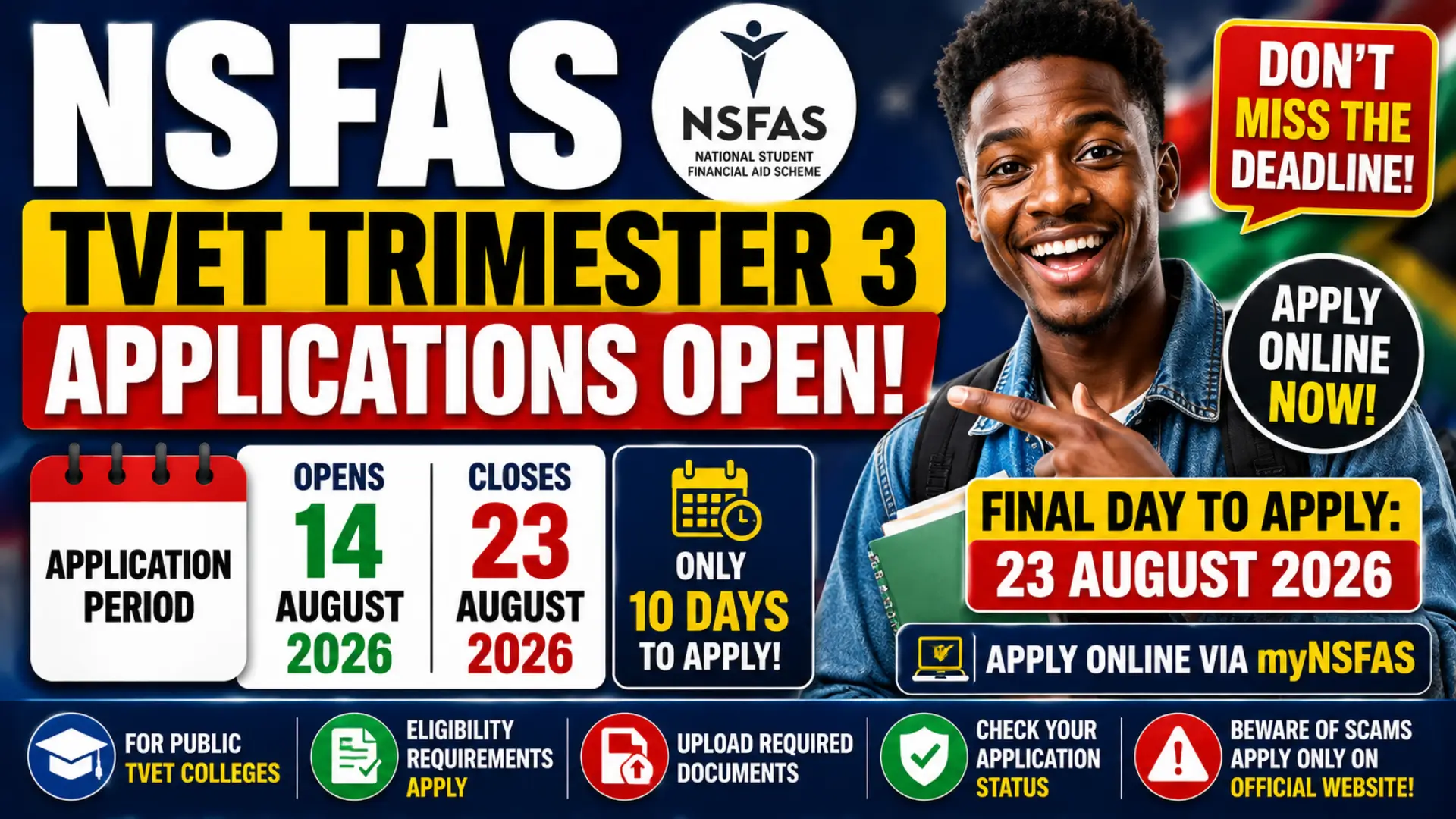
The 2026 NSFAS TVET Trimester 3 applications are now open, giving eligible students another opportunity to apply for financial support for the third trimester at public TVET colleges. According to the latest NSFAS notice, applications opened on 14 August 2026 and will close on 23 August 2026. This means 23 August 2026 is the final day to submit a Trimester 3 application.
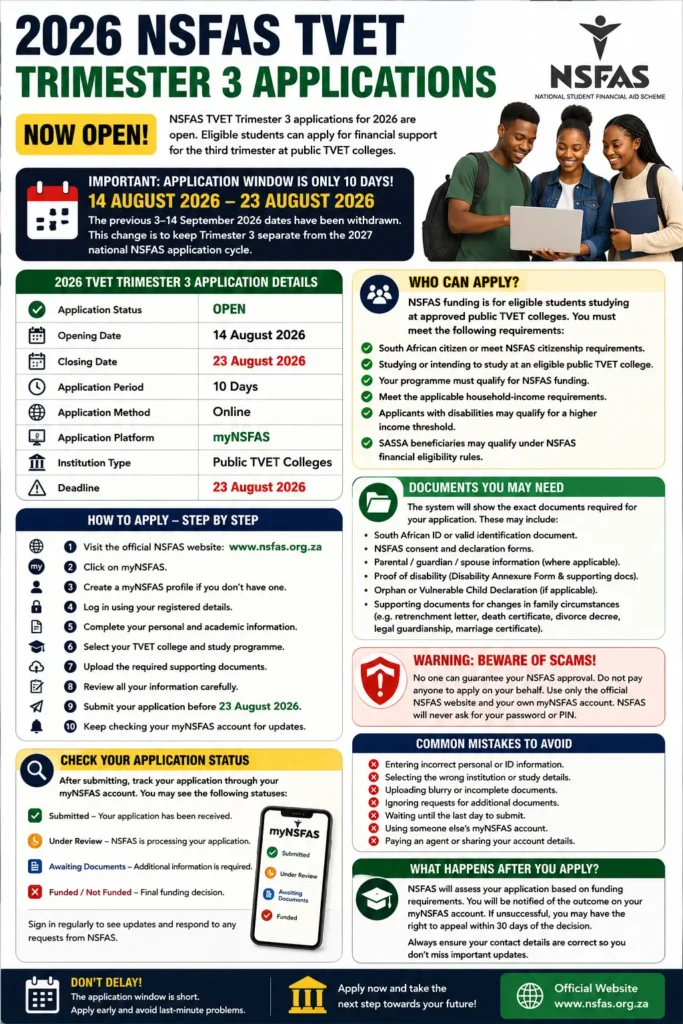
Students who intend to study during the 2026 TVET Trimester 3 period should not wait until the final hours. Applications are submitted online through the official NSFAS system, and applicants should make sure their personal information, college details and supporting documents are accurate before submitting.
2026 NSFAS TVET Trimester 3 Application Deadline
NSFAS originally communicated a different application period for TVET Trimester 3, but the dates were revised. The previous 3–14 September 2026 window has been withdrawn and replaced with the earlier 14–23 August 2026 application period.
You can also read: COVID-19 SRD Payment Dates
The change was made to keep the Trimester 3 application period separate from the national NSFAS application cycle for the 2027 academic year. Applicants should therefore rely on the revised August dates rather than older information circulating online.
| Important Detail | 2026 TVET Trimester 3 Information |
|---|---|
| Application status | OPEN |
| Opening date | 14 August 2026 |
| Closing date | 23 August 2026 |
| Application period | 10 days |
| Application method | Online |
| Application platform | myNSFAS |
| Institution type | Public TVET Colleges |
| Deadline | 23 August 2026 |
Because the deadline is approaching, eligible students should complete their applications as soon as possible. NSFAS also advises applicants to monitor their myNSFAS accounts for application updates and any further action required.
Who Can Apply for NSFAS TVET Trimester 3?
NSFAS funding is intended for eligible students studying at approved public institutions. For TVET applicants, the relevant programme and institution must meet the applicable NSFAS funding requirements. Applicants should also satisfy the financial and citizenship requirements set out in the 2026 NSFAS bursary guidelines.
The commonly important eligibility conditions include:
- You must be a South African citizen or meet the applicable NSFAS citizenship requirements.
- You must be studying or intending to study at an eligible public TVET college.
- Your programme must qualify for NSFAS funding.
- You must meet the applicable household-income requirements.
- Applicants with disabilities may be subject to a higher household-income threshold under the NSFAS rules.
- SASSA beneficiaries may qualify under NSFAS’s applicable financial eligibility assessment.
Meeting the financial requirement alone does not guarantee funding. NSFAS also checks other eligibility conditions, including the qualification, institution and information supplied in the application.
How to Apply for 2026 NSFAS TVET Trimester 3
The application process is completed online through the official NSFAS website and myNSFAS platform. NSFAS’s official application guidance says applicants should create a myNSFAS profile, complete the required information and submit the application.
Step-by-Step Application Process
Follow these steps to submit your application:
- Visit the official NSFAS website.
- Select the myNSFAS option.
- Create a myNSFAS profile if you do not already have one.
- Log in using your registered details.
- Complete the required personal and academic information.
- Select the appropriate TVET college and study information.
- Upload any supporting documents requested by the system.
- Carefully review your information before submitting.
- Submit the application before 23 August 2026.
- Keep checking your myNSFAS account for updates or requests for additional information.
Do not assume that creating an account means you have applied. The application must be completed and submitted successfully through the portal.
Documents You May Need for Your NSFAS Application
The exact supporting documents can depend on the applicant’s circumstances. NSFAS states that the system can generate a list of required documents based on the application type.
Applicants may be asked for documents such as:
- South African ID or acceptable identification documentation.
- NSFAS consent documentation where applicable.
- Declaration documentation where required.
- Proof relating to parental, guardian or spouse information where applicable.
- Disability Annexure Form and supporting medical information for applicants with disabilities.
- Orphan or Vulnerable Child Declaration Form where applicable.
- Supporting documents relating to changes in family circumstances, such as a retrenchment letter, death certificate, divorce decree, legal guardianship or marriage certificate.
Make sure uploaded documents are clear and readable. If NSFAS requests additional documents after submission, upload them through the myNSFAS account rather than ignoring the notification.
You can also read: SASSA Gold Card Ending Soon: 31 August
Why You Should Apply Before 23 August
The most important point for prospective Trimester 3 students is that the application window is short. NSFAS has confirmed that the revised window runs from 14 August to 23 August 2026, giving applicants only 10 days to submit their applications.
Waiting until the deadline can create unnecessary problems if you experience an account, document-upload or internet issue. Submitting early also gives you more time to check your myNSFAS account if NSFAS asks for additional information.
How to Check Your NSFAS Application Status
After submitting an application, you can monitor its progress through your myNSFAS account. NSFAS provides an online application-status tracking process where students can sign in and view the current status of their application.
Depending on the stage of processing, your account may indicate that your application has been submitted, is under review, requires documents or has reached a funding decision. Check the portal regularly instead of relying only on social-media posts or messages from third parties.
Common NSFAS Application Mistakes to Avoid
A rushed application can lead to avoidable problems. Before submitting your Trimester 3 application, carefully check that the information you provide matches your official documents and personal circumstances.
Avoid these common mistakes:
- Entering incorrect personal or identification information.
- Selecting the wrong institution or study details.
- Uploading unclear or incomplete documents.
- Ignoring requests for additional supporting documents.
- Using someone else’s myNSFAS account.
- Waiting until the final day to submit.
- Paying an unofficial person or agent to submit an application for you.
- Sharing your myNSFAS password or other sensitive account information.
NSFAS specifically warns applicants to protect their personal information and states that officials will not ask students to share their passwords.
Important Warning About NSFAS Scams
Applicants should be careful of social-media posts, WhatsApp messages and individuals promising guaranteed NSFAS approval in exchange for money. A legitimate application does not require applicants to pay an unofficial agent to secure funding.
Use the official NSFAS website and your own myNSFAS account when applying. NSFAS also maintains a zero-tolerance policy toward fraud, bribery and corruption and provides channels for reporting suspected unethical activity.
What Happens After You Submit?
Submitting an application does not immediately mean that funding has been approved. NSFAS must assess the information supplied by the applicant and determine whether the student meets the applicable funding requirements.
For this reason, keep monitoring your myNSFAS account after submission. If NSFAS requests additional documentation, respond through the official portal as soon as possible so that your application can continue through the assessment process.
Can You Apply If You Have Already Started Your TVET Studies?
Students should consider the specific NSFAS funding rules that apply to their TVET qualification and academic term. NSFAS’s 2026 guidelines recognize that a TVET academic term can be structured as a year, semester or trimester, depending on the qualification.
You can also read: Sassa September 2026 Grant Dates
The Trimester 3 application window is specifically intended for eligible students who need funding for the relevant 2026 TVET Trimester 3 period. If you are unsure whether your programme qualifies, confirm the details with your TVET college and check the information provided by NSFAS rather than submitting an application based on assumptions.
What If Your NSFAS Application Is Rejected?
A rejected application does not necessarily mean there is no further option. NSFAS has an appeals process for applicants who are eligible to appeal a funding decision.
NSFAS states that eligible unsuccessful applicants generally have 30 days after the unsuccessful determination to submit an appeal. The appeal should address the reason for rejection and include relevant supporting evidence where required.
Conclusion
The 2026 NSFAS TVET Trimester 3 application window is open from 14 August until 23 August 2026. The previously announced September dates have been withdrawn, so applicants should not rely on older information showing 3–14 September.
You can also read: Petrol and Diesel Price Hike September
If you are eligible and intend to study during Trimester 3, submit your application through the official myNSFAS platform before the deadline. After submitting, continue checking your account for status changes, missing-document requests and other important NSFAS communication.