Petrol and Diesel Price Hike September 2026 In South Africa
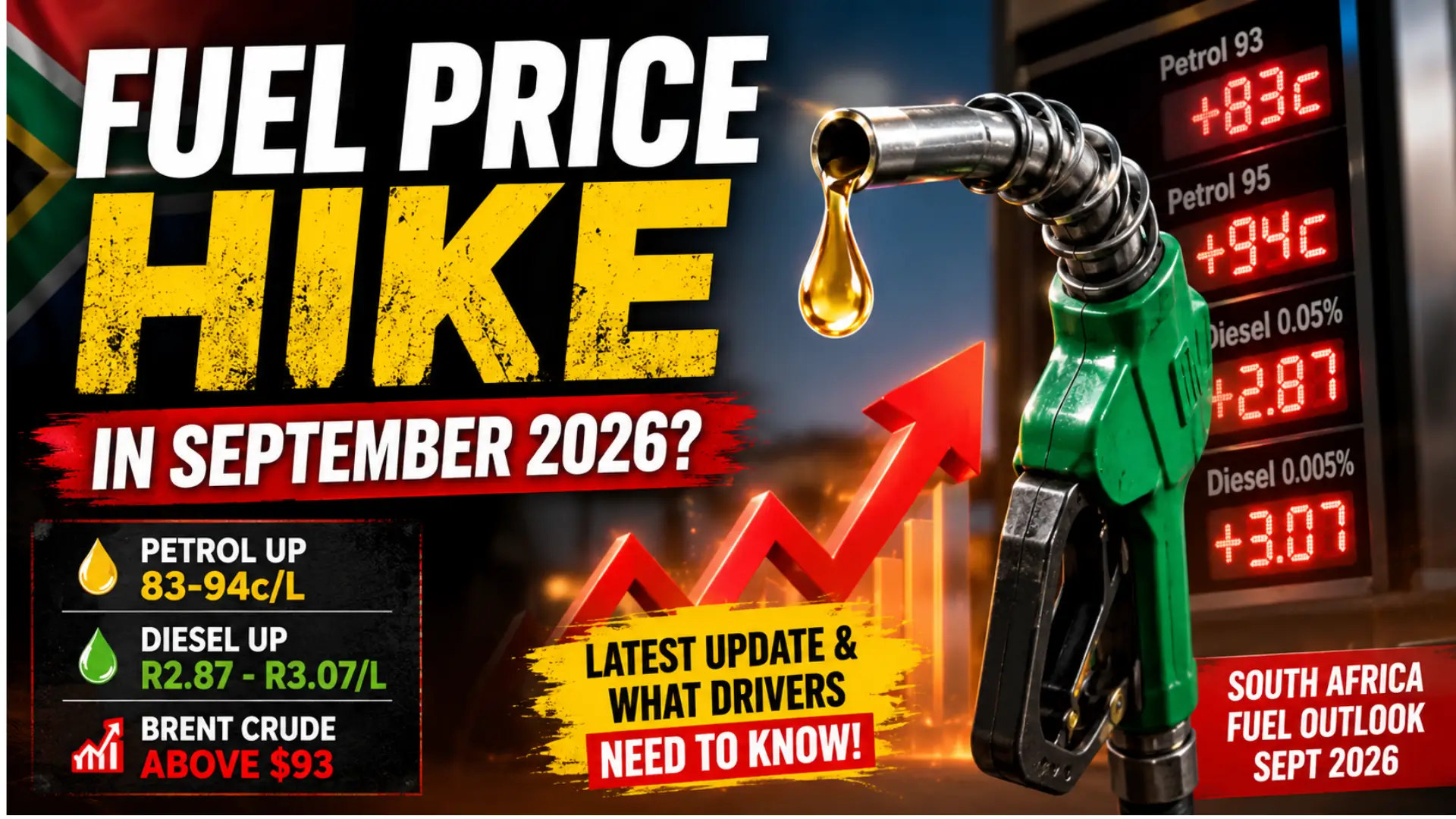
South African motorists are facing fresh fuel-price pressure heading into September 2026, with rising international oil prices threatening to reverse some of the relief seen at petrol stations earlier in the year. Brent crude recently moved above $93 a barrel, while the latest mid-month fuel data pointed to significant under-recoveries for both petrol and diesel.
Although the final September 2026 fuel price adjustment has not yet been confirmed, the available indicators suggest that motorists should prepare for possible increases. This article explains the latest petrol and diesel price hike outlook, why fuel prices are rising, the expected impact on households and inflation, and what drivers can do to manage higher transport costs.
September 2026 Fuel Price Hike at a Glance
The Central Energy Fund’s figures at the end of the third week of August showed an under-recovery that pointed towards higher fuel prices if market conditions remained similar through the end of the month. Petrol faced a sizeable possible increase, while diesel showed even stronger upward pressure.
You can also read: Sassa September 2026 Grant Dates
The figures below are indicators rather than the final official September adjustment. South Africa’s fuel price is calculated using several factors, so movements in Brent crude, the rand and international refined-fuel prices can still change the final outcome before the new monthly prices take effect.
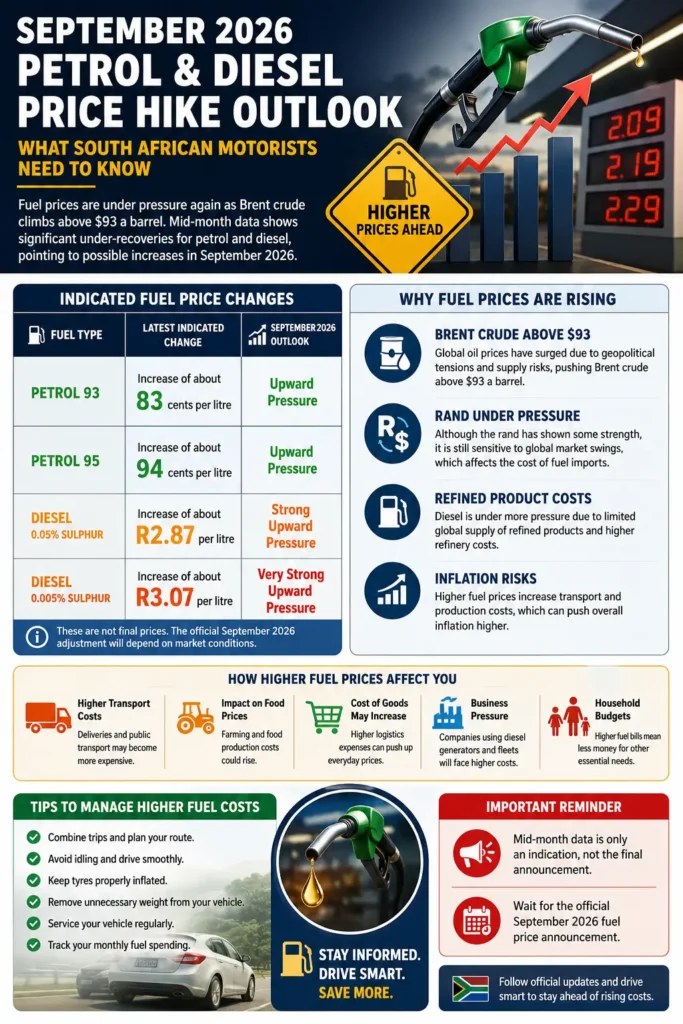
| Fuel Type | Latest Indicated Change | September 2026 Outlook |
|---|---|---|
| Petrol 93 | Increase of about 83 cents per litre | Upward pressure |
| Petrol 95 | Increase of about 94 cents per litre | Upward pressure |
| Diesel 0.05% sulphur | Increase of about R2.87 per litre | Strong upward pressure |
| Diesel 0.005% sulphur | Increase of about R3.07 per litre | Very strong upward pressure |
These Are Not Yet the Final September Prices
A common mistake is to treat mid-month under-recovery data as the official fuel price announcement. The final petrol and diesel prices depend on market movements throughout the fuel-price review period, which means the expected increase can still become smaller or larger.
Motorists should therefore use these figures as an early warning rather than a guaranteed final price. The official September 2026 adjustment will provide the confirmed change and the applicable retail prices for each fuel zone.
Why Are Petrol and Diesel Prices Expected to Rise in September 2026?
The main reason behind the September 2026 fuel price hike risk is the sharp increase in international oil prices. Brent crude climbed above $93 a barrel after trading closer to $70 at the beginning of July, increasing the cost pressure on countries that depend heavily on imported crude and petroleum products.
South Africa is particularly exposed because international oil prices are converted into rand. This means local motorists can be affected by two major forces at the same time: a higher dollar oil price and a weaker rand. A stronger rand can reduce some of the damage, but it may not fully protect consumers when crude and refined-product prices rise sharply.
Brent Crude Above $93 Creates Fresh Pressure
Brent crude is one of the most important global benchmarks influencing South Africa’s fuel costs. Recent uncertainty surrounding the reopening of the Strait of Hormuz and continuing geopolitical risks in the Middle East have added pressure to global energy markets.
When crude oil becomes more expensive, the effect does not always appear immediately at South African filling stations. However, sustained higher prices can feed into the monthly fuel-price calculation and eventually result in higher petrol and diesel prices.
The Rand Is Providing Some Protection
The rand was trading at about R16.06 to the US dollar, supported by a softer dollar and stronger emerging-market and commodity currencies. This has helped reduce some of the impact of higher oil prices because fuel imports are generally priced in US dollars.
You can also read: COVID-19 SRD Payment Dates
However, currency support alone may not be enough if Brent crude remains above $90 or continues climbing. South African motorists should watch both the oil price and the USD/ZAR exchange rate instead of focusing on only one indicator.
Why Is Diesel Facing a Bigger Possible Increase?
Diesel was showing substantially greater under-recovery pressure than petrol. The latest figures pointed to possible increases approaching R3 per litre or more for some diesel grades, making the September outlook especially important for businesses, farmers, transport operators and households that rely on diesel-powered services.
Diesel prices can react strongly when international markets face shortages of refined products or disruptions to middle-distillate supply. Unlike crude oil alone, diesel costs are also influenced by global refinery capacity and the availability of refined fuel, which can cause sharper price movements.
Possible Effects of Higher Diesel Prices
A major diesel increase can affect more than motorists because diesel is widely used across South Africa’s economy. Higher costs may eventually filter through to other prices.
- Transport and delivery costs may increase.
- Farming and food production costs could come under pressure.
- Logistics companies may face higher operating expenses.
- Businesses using diesel generators could experience higher costs.
- Food and consumer goods prices may eventually rise if transport expenses increase.
This is why economists often watch diesel prices closely when assessing future inflation risks.
How July’s Fuel Relief Helped South African Inflation
South African motorists received meaningful fuel-price relief in July 2026 when lower international oil prices contributed to a substantial petrol price reduction. Economists estimated that the R1.96 per litre petrol decrease reduced monthly inflation by approximately 0.4 percentage points.
The impact was significant enough that, without the benefit of lower fuel prices, July’s headline inflation would have been higher. This shows how quickly fuel prices can influence household budgets and the broader economy.
Fuel Inflation Was Still High Despite the July Cut
Even after the July reduction, fuel costs remained significantly higher than a year earlier. Fuel inflation was reported at 20.6% year-on-year in July, with petrol about R4.23 per litre more expensive than the previous year and diesel approximately R5.40 per litre higher.
This means that the July reduction offered temporary relief but did not completely remove the longer-term cost burden. A major September 2026 fuel price increase could therefore place renewed pressure on consumers who were only beginning to benefit from lower transport costs.
August Fuel Trends Added to the Concern
The July decline was followed by renewed pressure during August. Petrol 95 and diesel had previously fallen by roughly 7% and 11% respectively during July, but diesel prices then increased further during August.
You can also read: Government Employees Pension Fund August 2026
The return of higher fuel costs highlights how quickly global energy markets can change. Motorists should avoid assuming that one month’s fuel decrease means prices will continue falling in the following months.
Inflation Risks Are Now Moving Higher
Economists have warned that South Africa’s inflation outlook faces several upside risks. Higher oil prices are a major concern because they can directly increase transport and fuel costs while indirectly raising the cost of goods and services.
Other risks include fertiliser supply constraints, weather-related pressures and expectations of higher future inflation. If elevated energy prices continue, inflation could remain above 4% towards the end of 2026.
What Could Happen to Petrol Prices in September 2026?
Based on the latest available under-recovery figures, petrol motorists could face an increase of roughly 83 cents per litre for 93 octane petrol and 94 cents per litre for 95 octane petrol if conditions remain similar through the final calculation period.
The actual increase could change before the official adjustment. A decline in Brent crude or further rand strength could reduce the final increase, while another jump in oil prices or a weaker rand could push the adjustment higher.
Simple Example of the Possible Impact on a Tank
The real cost to a motorist depends on the size of the fuel tank. Using an indicative 94-cent-per-litre increase for 95 petrol:
- A 40-litre fill-up could cost about R37.60 more.
- A 50-litre fill-up could cost about R47 more.
- A 60-litre fill-up could cost about R56.40 more.
These examples are based on the indicated increase and are not final September 2026 prices.
When Will the Final September 2026 Fuel Prices Be Known?
South Africa’s fuel prices are normally adjusted monthly, with the final change based on the full review period rather than a single day’s market movement. The official announcement should therefore be treated as the final source for the confirmed petrol and diesel price adjustment.
Motorists should wait for the official September 2026 fuel price announcement before making financial decisions based on a specific per-litre increase. Early CEF under-recovery data is useful for tracking the direction of prices, but it is not a replacement for the final adjustment.
What Drivers Should Check Before Filling Up
To avoid confusion, check the following information as the official price announcement approaches:
- The final petrol 93 and petrol 95 price changes.
- The correct diesel grade and sulphur specification.
- Whether your area uses a different inland or coastal fuel price.
- The official effective date for the new prices.
- The latest movement in Brent crude and the rand before the adjustment.
Checking the correct fuel grade is especially important because diesel prices can differ significantly depending on sulphur content.
Practical Tips to Reduce the Impact of Higher Fuel Prices
Motorists cannot control the international oil market, but small changes in driving and vehicle use can help reduce fuel consumption. The best approach is to focus on consistent habits rather than making one-off changes only when prices rise.
Simple steps can reduce unnecessary fuel use:
- Combine several errands into one trip where possible.
- Avoid unnecessary idling.
- Keep tyres properly inflated according to the vehicle manufacturer’s guidance.
- Drive smoothly and avoid repeated harsh acceleration.
- Remove unnecessary heavy items from the vehicle.
- Keep up with basic vehicle maintenance.
- Compare travel options for longer regular journeys.
- Track monthly fuel spending to identify unnecessary trips.
These measures may not completely offset a major price increase, but they can reduce the total impact over time.
Common Mistakes Motorists Should Avoid
The biggest mistake is rushing to fill up based on unofficial social-media posts claiming that a specific September fuel increase has already been confirmed. Fuel-price forecasts can change, and different reports may confuse early estimates with the final official adjustment.
Another mistake is focusing only on the petrol price. Diesel increases can have a wider indirect effect through food transport, deliveries, agriculture and logistics. Even people who do not drive regularly may feel the consequences if higher diesel costs eventually push up the prices of everyday goods.
September 2026 Petrol and Diesel Price Hike
Higher fuel prices place direct pressure on households that depend on private vehicles for work, school, healthcare and daily travel. A large diesel increase can also raise broader living costs, particularly when businesses pass higher transport expenses through the supply chain.
The biggest concern is that the recent improvement in inflation could prove temporary if Brent crude remains elevated. South Africa benefited from lower fuel prices in July, but a sustained rise in global energy prices could reverse part of that relief during the final months of 2026.
Conclusion
The outlook for the September 2026 petrol and diesel price adjustment is currently concerning, with the latest under-recovery data pointing towards increases across major fuel grades. Petrol was showing possible increases of around 83 to 94 cents per litre, while diesel faced much heavier upward pressure of nearly R3 per litre or more for certain grades.
You can also read: Sassa September 2026 Grant Dates
However, these figures are still indicators rather than final official prices. Motorists should closely follow the confirmed September 2026 fuel price announcement, while keeping an eye on Brent crude and the rand. For now, the best strategy is to prepare for higher transport costs, avoid relying on unconfirmed claims, and take practical steps to reduce unnecessary fuel consumption.