South Africa Introduces New R500 ETA Fee: What Travellers Need to Know

South Africa has introduced a new R500 electronic processing fee for its Electronic Travel Authorisation (ETA) system. The fee was formally introduced through visa fee amendments gazetted on Monday, 17 August 2026, shortly after the official launch of the digital ETA platform.
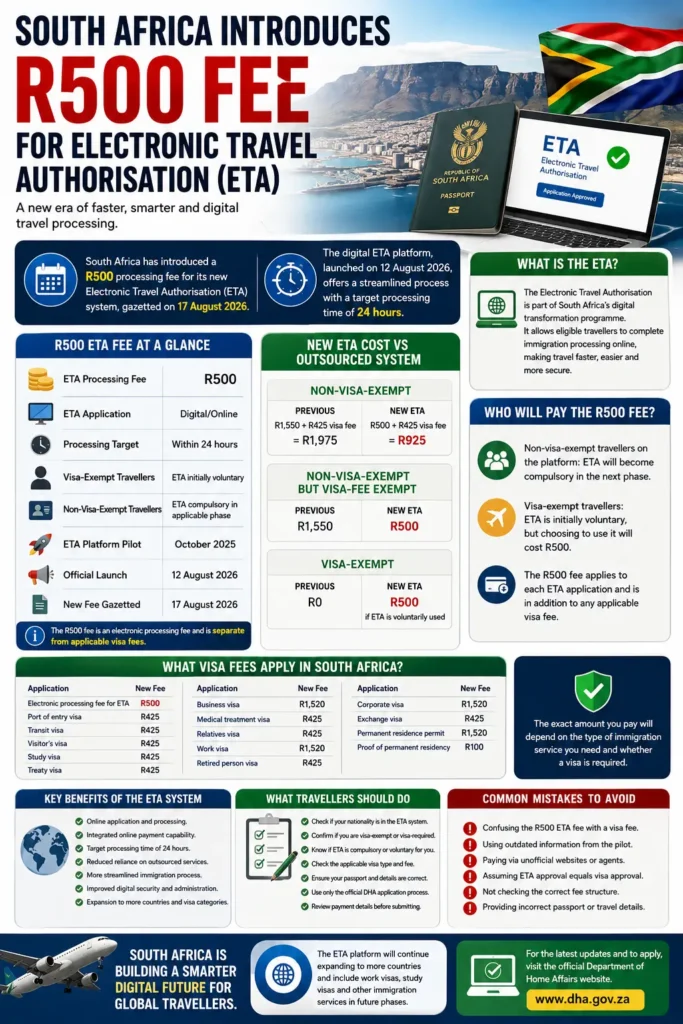
The new fee is important for international travellers planning to visit South Africa because the cost and application requirements will depend on whether a traveller is visa-exempt or normally requires a visa. The Department of Home Affairs (DHA) says the new digital system is designed to make immigration processing faster, more secure and easier to manage online.
What Is the South Africa ETA?
The Electronic Travel Authorisation (ETA) is part of the Department of Home Affairs’ digital transformation programme. It allows eligible international travellers to complete travel-related immigration processing electronically rather than relying entirely on traditional application procedures.
You can also read: Sassa Gold Card Replacement Details
The ETA platform was first piloted in October 2025 for nationals of participating countries. President Cyril Ramaphosa officially launched the system with the DHA at OR Tambo International Airport on 12 August 2026, marking the start of its wider rollout.
The system is designed to provide a streamlined digital process, with applications intended to be processed within 24 hours. The government also plans to expand the platform to additional countries and immigration categories over time.
Why Has South Africa Introduced a R500 ETA Fee?
During the first phase of the ETA system, visa fees for participating countries were temporarily waived. According to DHA Minister Leon Schreiber, this was because the platform did not yet have an integrated online payment facility.
That situation has now changed. With the official launch of the system and online payment functionality available, the government has introduced a R500 ETA processing fee for each application. The fee is intended to cover the cost of the digital processing service that is now being handled within the DHA’s own system.
The R500 ETA Fee at a Glance
| Item | New Requirement |
|---|---|
| ETA processing fee | R500 |
| ETA application | Digital/online |
| Processing target | Within 24 hours |
| Visa-exempt travellers | ETA initially voluntary |
| Non-visa-exempt travellers on the platform | ETA compulsory in the applicable phase |
| ETA platform pilot | October 2025 |
| Official launch | 12 August 2026 |
| New fee gazetted | 17 August 2026 |
The R500 charge is therefore separate from applicable visa fees. Travellers should check which category applies to them before assuming that R500 is the complete cost of travel authorisation.
Who Will Have to Pay the R500 ETA Fee?
The answer depends on the traveller’s nationality and visa status. For non-visa-exempt travellers included on the ETA platform, the ETA is expected to become compulsory as the system moves into its next phase.
For travellers who are visa-exempt, the ETA is initially voluntary. However, the DHA expects many visa-exempt travellers to use the platform because of its digital convenience and faster processing.
Under the new fee structure, even a visa-exempt traveller who voluntarily chooses to use the ETA platform will pay the R500 processing fee.
How Much Will a Non-Visa-Exempt Traveller Pay?
For a traveller who requires a visa and is subject to the standard visitor visa fee, the total cost can be R925 under the new ETA structure. This consists of the R500 ETA processing fee plus the R425 applicable visa fee.
The DHA says this represents a significant reduction compared with the previous outsourced arrangement. Travellers should nevertheless confirm their exact visa category because different visa types can have different fees.
New ETA Cost Compared With the Outsourced System
| Traveller category | Previous outsourced structure | New ETA structure |
| Non-visa-exempt | R1,550 + R425 visa fee = R1,975 | R500 + R425 visa fee = R925 |
| Non-visa-exempt but visa-fee exempt | R1,550 | R500 |
| Visa-exempt | R0 | R500 if ETA is voluntarily used |
The comparison shows why the DHA describes the new system as a potential saving for travellers who previously had to use an outsourced service provider. The digital ETA processing fee is substantially lower than the former R1,550 outsourced service charge.
What Visa Fees Apply in South Africa?
The new R500 ETA processing charge does not replace South Africa’s existing visa fees. Instead, it is an electronic processing fee that can be added to the relevant visa cost where applicable.
The amended fees include the following major categories:
| Application | New Fee |
| Electronic processing fee for ETA | R500 |
| Port of entry visa | R425 |
| Transit visa | R425 |
| Visitor’s visa | R425 |
| Study visa | R425 |
| Treaty visa | R425 |
| Business visa | R1,520 |
| Medical treatment visa | R425 |
| Relatives visa | R425 |
| Work visa | R1,520 |
| Retired person visa | R425 |
| Corporate visa | R1,520 |
| Exchange visa | R425 |
| Permanent residence permit | R1,520 |
| Proof of permanent residency | R100 |
The exact amount a traveller pays will depend on the type of immigration service being requested and whether the traveller is required to obtain a visa.
Is the ETA Compulsory for Visa-Exempt Travellers?
Not initially. The DHA has said that the ETA will initially remain optional for visa-exempt travellers. This means eligible visa-exempt visitors can choose whether to use the digital system during this stage.
However, the department expects strong uptake because the ETA is intended to improve efficiency and security. The government has also indicated that the system could eventually become more broadly applicable as its rollout expands.
Travellers should therefore avoid relying on older information about South Africa’s immigration procedures. ETA requirements can change as additional countries and traveller categories are added to the platform.
You can also read: SASSA Grant Payment Dates September 2026
What About Travellers Who Need a Visa?
For travellers from participating countries who are not visa-exempt, the ETA is expected to become compulsory under the next phase of implementation. This means travellers should pay attention to both requirements: the relevant South African visa and the ETA processing requirement.
Paying the R500 ETA fee does not automatically mean that a traveller has received a visa if a visa is separately required. Before travelling, applicants should confirm their nationality’s current status, the applicable visa category and whether the ETA is compulsory for their journey.
How the New ETA System Could Make Travel Easier
One of the main purposes of the new system is to replace slower and more complicated immigration processes with a digital workflow. The DHA says applications can be processed seamlessly online, with a target processing time of 24 hours.
The system also provides an integrated online payment capability, which was missing during the initial pilot. This allows the DHA to collect the processing fee directly as part of the digital application process.
Main benefits of the ETA system include:
- Online application and processing.
- Integrated online payment capability.
- Target processing time of 24 hours.
- Reduced reliance on outsourced processing services.
- A more streamlined immigration process.
- Improved digital security and administration.
- Potential expansion to additional countries and visa categories.
The faster digital process could be particularly useful for travellers who want to complete immigration formalities before travelling rather than depending on traditional procedures.
Will the ETA Eventually Cover Work and Study Visas?
The government’s plans extend beyond short-term travel. President Cyril Ramaphosa said South Africa intends to expand the system to additional countries and eventually use digital processing for work visas, study visas and other immigration services.
This means the ETA platform is being developed as part of a broader digital immigration strategy rather than simply as a replacement for one travel document.
The expansion is expected to take place in stages. Travellers should therefore check the latest DHA requirements before applying because not every visa or nationality will necessarily be covered by the same rules at the same time.
What Travellers Should Do Before Applying
The introduction of the R500 fee makes it more important for applicants to understand their requirements before submitting an application. A traveller should not assume that the ETA fee covers every immigration charge.
Before submitting an ETA application, check:
- Whether your nationality is included in the ETA system.
- Whether you are visa-exempt or visa-required.
- Whether the ETA is compulsory or voluntary for your category.
- Which visa type applies to your trip.
- The applicable visa fee, if any.
- That your passport and personal details are entered correctly.
- That you are using the official DHA application process.
- That your payment details are correct before completing the transaction.
Checking these details first can help prevent avoidable application problems and unexpected costs.
Common Mistakes Travellers Should Avoid
A common mistake is treating the R500 ETA fee as the same thing as a visa fee. They are not necessarily the same charge. A traveller who requires a visa may need to pay both the ETA processing fee and the relevant visa fee.
Another mistake is relying on outdated information from the initial ETA pilot. The platform’s rules and payment arrangements have changed since the pilot period, so information published before the August 2026 launch may no longer reflect the current fee structure.
Travellers should also be careful about unofficial websites or intermediaries claiming to provide faster ETA processing. Since the DHA has introduced an integrated online payment system, applicants should verify that they are using the correct official application channel before entering passport or payment information.
You can also read: SASSA SRD R370 September 2026
Is the New R500 Fee More Expensive Than Before?
For many travellers who previously used outsourced ETA services, the answer is no. The DHA says the new in-sourced system reduces the processing charge from R1,550 to R500.
For example, a non-visa-exempt traveller subject to a R425 visa fee previously faced a combined cost of R1,975 under the outsourced model. Under the new structure, the combined amount becomes R925.
However, visa-exempt travellers should understand the difference. They previously paid no ETA fee because they did not need the service, while choosing to use the new voluntary ETA will now cost R500.
South Africa Plans Further ETA Expansion
The introduction of the R500 fee is only one part of South Africa’s wider immigration digitalisation programme. The government intends to extend the platform to more countries and eventually introduce digital processing for additional immigration services.
This could make the ETA platform increasingly important for international visitors, students, workers and other foreign nationals seeking permission to enter or remain in South Africa.
As the rollout continues, requirements may differ depending on nationality, visa status and the type of travel. Checking the latest official DHA information before making travel arrangements is therefore essential.
Conclusion
South Africa has officially introduced a R500 processing fee for Electronic Travel Authorisation applications, following the launch of its new digital immigration platform. The fee was gazetted on 17 August 2026 and applies to ETA applications under the new fee structure.
For non-visa-exempt travellers who also need a standard R425 visa, the combined cost under the new structure can be R925, compared with R1,975 under the previous outsourced arrangement. Visa-exempt travellers can initially use the ETA voluntarily for R500.