South Africa Digital Banking Losses Soar as App Scams Cost R2.4 Billion
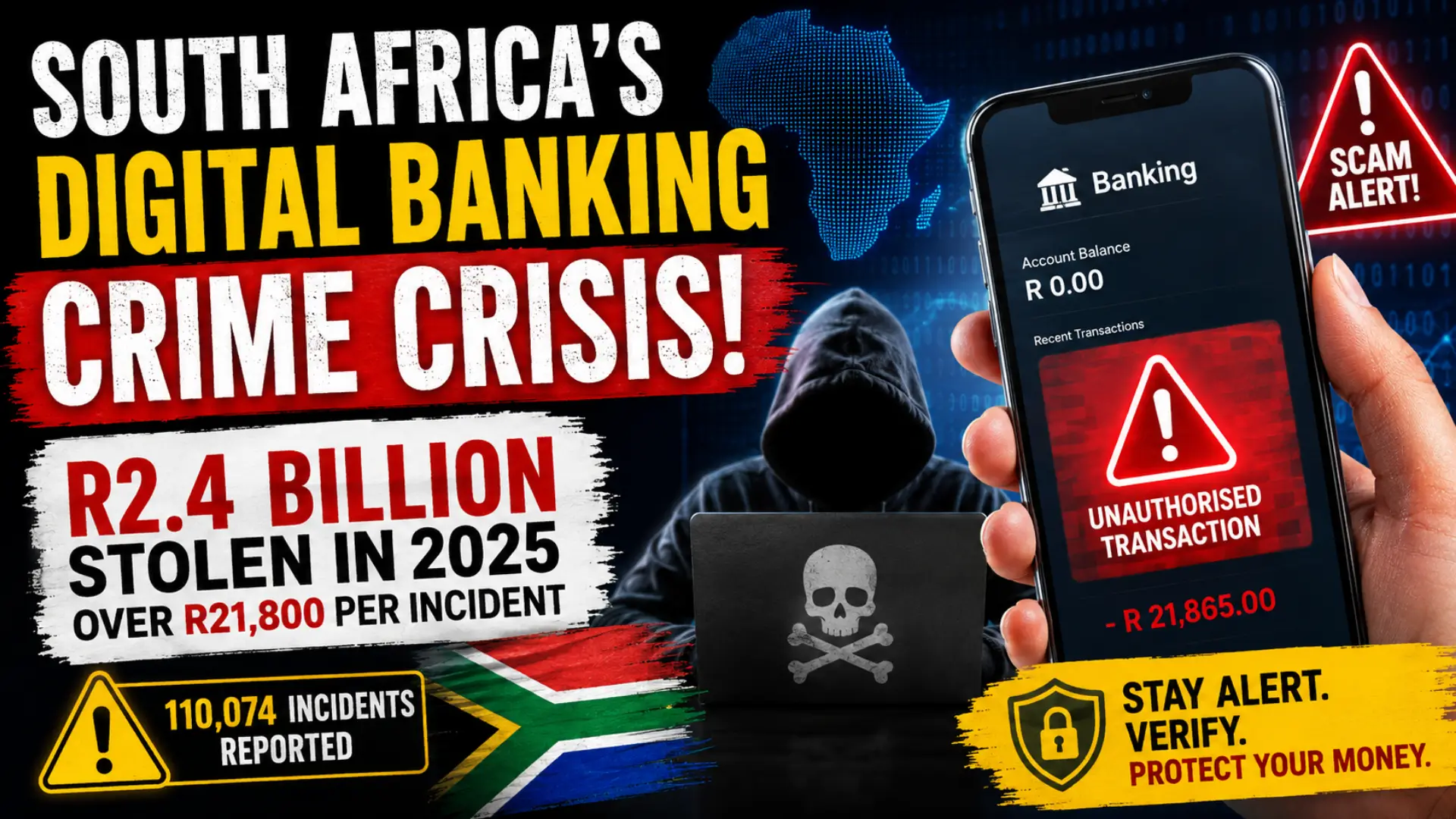
South Africa’s digital banking crime problem reached a worrying new level in 2025, with reported client losses climbing to R2.4 billion. According to the South African Banking Risk Information Centre (SABRIC) 2025 Annual Crime Statistics Report, these losses were spread across 110,074 reported incidents, showing how frequently criminals are targeting bank customers through digital channels.
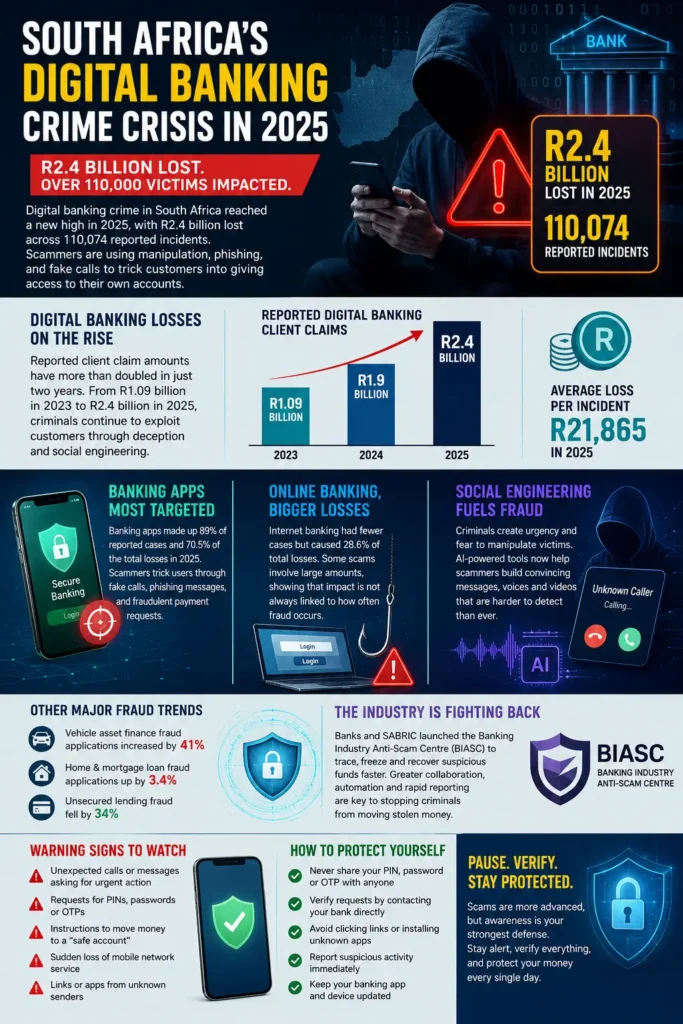
The increase highlights an important change in modern banking crime. Criminals are often not breaking directly into banking systems. Instead, they are manipulating customers through fake calls, phishing messages, impersonation, false payment requests and other scams designed to gain access to accounts or convince victims to approve transactions themselves.
Digital Banking Crime Statistics for 2025
The latest figures show that financial losses linked to digital banking crime have increased sharply over the past few years. Reported client claim amounts rose from R1.09 billion in 2023 to R2.4 billion in 2025, more than doubling in just two years.
You can also read: Postbank Sassa Gold Card Deadline
Based on the 110,074 incidents reported during 2025, the average reported loss was approximately R21,865 per incident. However, this average does not mean every victim lost the same amount, as some scams involve relatively small transactions while others result in much larger financial losses.
| Year | Reported Digital Banking Client Claims | Change |
|---|---|---|
| 2023 | R1.09 billion | — |
| 2024 | About R1.9 billion | Significant increase |
| 2025 | R2.4 billion | 29.2% increase from 2024 |
The figures show why digital banking security has become a major concern for consumers, banks and fraud investigators across South Africa.
Why Banking App Scams Account for Most Cases
Banking apps accounted for approximately 89% of reported digital banking crime cases in 2025. They were also linked to 70.5% of the total client claim amount, making app-related fraud the dominant form of reported digital banking crime.
This does not necessarily mean banking apps themselves are insecure. A major issue is that criminals target the person using the app. If a scammer convinces a customer to reveal confidential information, install remote-access software or approve a fraudulent transaction, the criminal may be able to exploit the customer’s access to the legitimate banking service.
Why Scammers Target Banking App Users
Banking apps are attractive targets because they give customers fast access to payments and account information. Criminals frequently rely on manipulation rather than technical attacks.
Common tactics include:
- Fake calls claiming to come from a bank or fraud department
- Phishing SMS messages and emails
- Requests for PINs or one-time passwords
- Fake warnings that an account is under attack
- Instructions to transfer money to a so-called “safe account”
- Requests to install remote-access software
- Fake investment, payment or refund messages
The biggest security lesson is simple: a convincing scam can still be fraudulent, even when the caller appears to know your name, bank or personal details.
Internet Banking, Mobile Banking and App Fraud Compared
While banking apps generated most reported cases, internet banking represented a much larger share of losses compared with its smaller number of incidents. SABRIC’s figures show that the impact of a scam is not always connected to how often that type of fraud occurs.
| Digital Banking Channel | Share of Reported Cases | Share of Client Claim Amount |
| Banking apps | About 89% | 70.5% |
| Internet banking | Less than 9% | 28.6% |
| Mobile banking | Less than 3% | Less than 1% |
Internet banking accounted for fewer than 9% of cases but almost 29% of the total claim value. This suggests that some internet banking incidents can result in substantial losses. Mobile banking made up a much smaller portion of reported cases and claim amounts but remains a concern because of its connection to risks such as SIM-swap fraud.
How Social Engineering and AI Are Driving Digital Banking Fraud
SABRIC said much of the digital banking crime reported in 2025 was driven by social engineering. This means criminals manipulate people into giving away information, approving transactions or taking actions that provide access to their accounts.
Artificial intelligence is making this problem more difficult because criminals can create increasingly convincing messages, images, voices and videos. A scam message may now sound more professional, while AI-assisted impersonation can make it harder for customers to identify fake communications.
You can also read: SASSA Gold Card Deadline 31 August 2026:
How Social Engineering Scams Usually Work
The criminal often creates a sense of urgency so the victim does not have enough time to think carefully.
Typical warning phrases include:
- “Your account has been compromised.”
- “You must act immediately.”
- “Move your money to a safe account.”
- “Read out the OTP we just sent you.”
- “Install this app so we can secure your device.”
- “Your SIM has been swapped. Verify your banking details now.”
A genuine security concern should always be checked independently. Do not rely only on the phone number, message or link provided by the person who contacted you.
Other Banking Fraud Trends Identified by SABRIC
Digital banking was not the only area of concern in 2025. SABRIC reported a significant increase in fraud involving vehicle asset finance applications, with fraudulent applications rising by 41% and the value of detected and declined fraudulent applications increasing by 43.8%.
Fraudulent home and mortgage loan applications increased by 3.4%, although potential losses declined by 12.3%. Unsecured lending fraud showed improvement, with reported fraudulent applications involving products such as current accounts, savings accounts, credit cards and personal loans falling by 34%.
Risks That Remain Despite Some Improvements
SABRIC warned that several fraud methods continue to create serious risks:
- Mule accounts used to receive or move stolen money
- Synthetic identities created using false or combined information
- First-party misrepresentation during applications
- AI-assisted document manipulation
- Card-not-present fraud
- Fraud involving stolen or compromised customer information
Card fraud also remained costly, with gross fraud losses on South African-issued credit and debit cards increasing by 18% during 2025.
How the Banking Industry Is Fighting Scam Networks
The banking industry has increased efforts to stop fraudulent funds from disappearing through multiple accounts. One important initiative is the Banking Industry Anti-Scam Centre (BIASC), established through participating banks and SABRIC.
The centre helps improve information sharing, case escalation and the speed of tracing and preserving suspicious funds. This is important because criminals often try to move stolen money quickly through several accounts before withdrawing it as cash or transferring it through other channels.
SABRIC said the anti-scam capability still needs greater scale, coverage and automation to have a bigger impact on overall industry losses. For customers, this means rapid reporting remains extremely important when suspicious activity is discovered.
Warning Signs Every South African Bank Customer Should Know
Most banking scams contain one or more warning signs. Recognising these signals early can prevent a rushed decision that results in financial loss.
Be particularly cautious when you receive:
- An unexpected call or message creating panic or urgency
- A request for your PIN, password or one-time password
- Instructions to move money to a “safe” account
- A request to install remote-access software
- A suspicious link asking you to log in
- An unexplained loss of mobile network service
- A caller claiming to be a bank employee who pressures you to act immediately
Remember that a bank employee may contact you for legitimate reasons, but you should independently verify unusual requests through an official banking channel.
You can also read: NSFAS Student DEBT
What to Do If You Suspect a Banking Scam
The most important action is to stop engaging with the suspicious person immediately. Do not send additional information, approve new transactions or follow instructions simply because the caller says the situation is urgent.
Take these steps as quickly as possible:
- End the call or close the suspicious message.
- Do not share your PIN, password or one-time password.
- Contact your bank using an official number or secure channel you independently locate.
- Report any suspicious or unauthorised transactions immediately.
- If your mobile service suddenly disappears, contact both your bank and mobile network provider.
- Change compromised credentials through legitimate banking channels if instructed by your bank.
- Keep relevant messages or transaction details available for the fraud report.
Fast action can be important because suspicious funds may be moved rapidly through multiple accounts.
Common Mistakes That Lead to Digital Banking Losses
One of the most common mistakes is believing that a caller is genuine simply because they know personal information. Criminals may obtain names, phone numbers or other details from data leaks, social media, public sources or previous scams.
Another major mistake is confusing urgency with legitimacy. A genuine security issue should not require you to reveal a PIN or one-time password to an unexpected caller. Customers should also avoid clicking links in suspicious messages or installing software because someone claiming to represent a bank told them to do so.
Mistakes to Avoid
- Never share a PIN or password with an unexpected caller
- Never reveal a one-time password to someone requesting it
- Do not transfer money to a “safe account” on an unsolicited instruction
- Avoid installing remote-access software at the request of an unknown caller
- Do not trust a caller ID as proof that a call is genuine
- Do not ignore unexpected SIM-swap or mobile service problems
- Do not delay reporting suspicious transactions
A few minutes spent independently checking a request can prevent a much larger financial loss.
You can also read: South Africa September Petrol Price
Best Practices to Protect Your Bank Account and Money
Good digital banking security depends on a combination of bank security systems and careful customer behaviour. The strongest protection is to slow down when something unexpected happens and verify information before taking action.
Useful habits include using strong and unique passwords, protecting your banking device, keeping banking apps updated and regularly reviewing account activity. Most importantly, treat unexpected requests involving money or security details with caution.
A Simple “Pause and Verify” Rule
Before approving an unusual banking action, ask yourself:
- Did I initiate this contact or transaction?
- Is someone creating pressure or urgency?
- Are they asking for confidential information?
- Have I independently contacted my bank through an official channel?
- Am I being told to move money to protect it?
- Does this request require me to install unfamiliar software?
If the answer raises doubts, stop and verify the situation independently before doing anything else.
Why SIM-Swap Fraud Requires Immediate Action
An unexpected loss of mobile network service can sometimes be a warning sign that requires urgent attention. Since mobile numbers may be linked to banking verification processes, criminals can attempt to exploit a compromised number to receive security messages or take control of accounts.
Customers should not assume a sudden loss of service is only a technical problem. Contacting both the bank and mobile network provider immediately can help establish whether a SIM-swap or another security issue has occurred.
Conclusion
The R2.4 billion lost to digital banking crime in South Africa during 2025 shows that banking fraud is becoming more sophisticated and more expensive. With banking apps accounting for the majority of reported cases, the biggest threat is increasingly focused on manipulating customers rather than directly attacking bank technology.
You can also read: SASSA Status Check SRD R370 Payment
The most effective response is awareness combined with fast action. South Africans should pause when faced with urgent banking requests, independently verify suspicious contact, protect PINs and one-time passwords, and report suspicious activity without delay. As AI and social engineering make scams harder to recognise, careful verification is no longer just a good security habit—it is an essential part of protecting your money.