South Africa Diesel Price Drop in June 2026

South African motorists and businesses received welcome news for June 2026 as diesel prices officially decreased across the country. While petrol users are facing another significant increase, diesel consumers will benefit from lower wholesale fuel costs, providing some relief amid ongoing economic pressures.
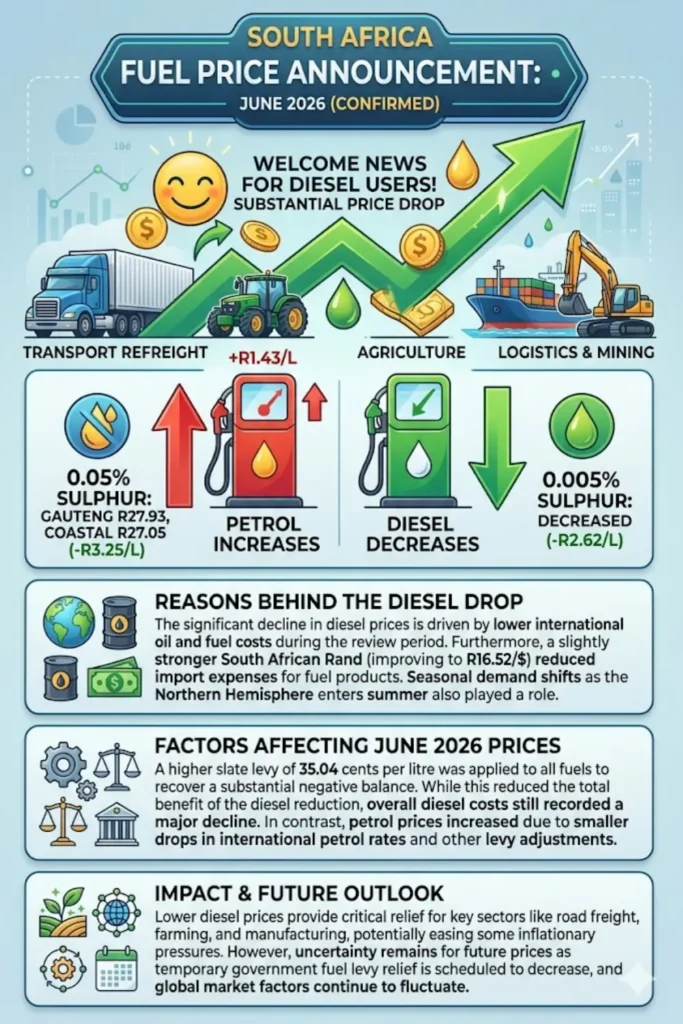
The latest fuel price adjustments announced by the Department of Petroleum and Mineral Resources (DPMR) highlight the different factors affecting petrol and diesel prices. Understanding these changes can help transport operators, farmers, businesses, and everyday consumers better manage their fuel expenses.
South Africa Diesel Price Drop Confirmed for June 2026
The Department of Petroleum and Mineral Resources confirmed that diesel prices will decrease from Wednesday, bringing much-needed relief to sectors heavily dependent on diesel-powered vehicles and equipment.
You can also read: Fuel Price June 2026 in South Africa
Although analysts had expected a slightly larger reduction, an increase in the slate levy reduced the overall benefit. Despite this adjustment, diesel prices still recorded a substantial decline compared to previous months.
New Diesel Prices for June 2026
The June fuel price adjustment includes reductions for both grades of diesel sold in South Africa.
Diesel 0.05% Sulphur Price
Wholesale diesel containing 0.05% sulphur decreased by R3.25 per litre.
Key June 2026 prices include:
- Gauteng: R27.93 per litre
- Coastal regions: R27.05 per litre
- Price reduction: R3.25 per litre
This grade is commonly used by commercial transport fleets, agricultural equipment, and heavy-duty vehicles.
Diesel 0.005% Sulphur Price
Diesel with 0.005% sulphur also became cheaper, although the reduction was slightly smaller.
Important changes include:
- Price reduction: R2.62 per litre
- Widely used in modern diesel engines
- Supports lower vehicle emissions
- Popular among logistics and transport operators
The reduction offers immediate savings for businesses operating large fleets across South Africa.
Why Diesel Prices Are Falling in June 2026
Several global and local market factors contributed to the diesel price decrease.
International fuel markets experienced declining prices during the review period. According to the DPMR, middle distillates such as diesel and paraffin saw larger price decreases than petrol.
Lower global fuel costs reduced import expenses for South Africa, allowing authorities to pass part of the savings on to consumers through lower diesel prices.
Stronger South African Rand
The South African rand strengthened slightly against the US dollar during the pricing period. The average exchange rate improved from R16.65/$ to R16.52/$.
A stronger rand makes imported fuel products less expensive because South Africa purchases crude oil and refined fuel products in US dollars. This currency improvement contributed approximately 12 to 15 cents per litre of fuel price relief.
Seasonal Demand Changes
Seasonal demand patterns also played a role. As the Northern Hemisphere enters summer, demand for certain heating-related fuel products decreases.
Lower seasonal demand often leads to reduced international diesel prices, which ultimately benefits South African consumers when monthly fuel price adjustments are calculated.
Why Petrol Prices Increased While Diesel Prices Fell
Many motorists are wondering why petrol prices increased sharply while diesel prices declined.
The primary reason is that international petrol prices did not fall as much as diesel prices. At the same time, government fuel levy adjustments and a higher slate levy placed additional pressure on petrol costs.
As a result, all grades of petrol increased by R1.43 per litre, pushing the price of 95 octane petrol to:
- R28.06 per litre in Gauteng
- R27.19 per litre at the coast
This marks another significant increase in fuel costs for petrol vehicle owners.
Impact of the Slate Levy on Fuel Prices
One of the most important factors affecting June 2026 fuel prices is the slate levy.
The slate fund recorded a negative balance of approximately R18.28 billion. To recover these costs, the slate levy increased by 35.04 cents per litre, rising from roughly R1.23 to over R1.57 per litre.
You can also read: June 2026 SASSA Grant Amounts
The slate fund exists to compensate fuel wholesalers when actual fuel costs exceed regulated monthly fuel prices. Consumers ultimately repay these costs through future levy adjustments.
June 2026 Fuel Price Comparison Table
| Fuel Type | June 2026 Adjustment | Gauteng Price | Coastal Price |
|---|---|---|---|
| Petrol 95 Octane | +R1.43/litre | R28.06 | R27.19 |
| Diesel 0.05% Sulphur | -R3.25/litre | R27.93 | R27.05 |
| Diesel 0.005% Sulphur | -R2.62/litre | Varies | Varies |
| Illuminating Paraffin (Wholesale) | -R5.96/litre | Varies | Varies |
| LPG Gas | -17c/kg to -20c/kg | Varies | Varies |
The table shows that diesel and paraffin users are benefiting from substantial reductions, while petrol users continue facing higher fuel costs.
What the Diesel Price Drop Means for South Africans
Lower diesel prices can have positive effects beyond the fuel station.
Potential benefits include:
- Reduced transport operating costs
- Lower agricultural production expenses
- Improved profitability for logistics companies
- Reduced fuel costs for mining operations
- Potential easing of inflationary pressure
While consumers may not immediately see lower retail prices for goods, reduced transport costs can help slow future price increases.
Industries That Benefit Most from Lower Diesel Prices
Certain sectors stand to gain significantly from the June 2026 diesel price reduction.
The biggest beneficiaries include:
- Road freight and logistics companies
- Farming and agricultural businesses
- Construction firms
- Mining operations
- Public transport operators
- Manufacturing companies using diesel-powered equipment
These industries consume large volumes of diesel and can experience meaningful cost savings from even small fuel price reductions.
Important Things Motorists Should Know
Diesel vehicle owners should keep several factors in mind following the June adjustment.
- The reduction applies primarily to wholesale diesel prices.
- Retail pricing may vary depending on location.
- Future adjustments remain dependent on global oil markets.
- Exchange rate fluctuations can quickly affect fuel prices.
- The slate levy remains a significant factor in fuel costs.
Monitoring monthly fuel announcements can help motorists and businesses plan fuel budgets more effectively.
Outlook for Fuel Prices in July 2026
While diesel users are benefiting from June’s reduction, uncertainty remains regarding future fuel price movements.
A major concern is the temporary fuel levy relief introduced by government. The relief was reduced significantly in June and is scheduled to fall away completely in July 2026. If international fuel prices or the exchange rate worsen, motorists could face additional price pressure in coming months.
You can also read: Sassa Payment Dates for June 2026
Global crude oil prices, geopolitical developments, shipping costs, and currency movements will remain the primary drivers of South Africa’s fuel prices going forward.
Final Thoughts
The South Africa diesel price drop in June 2026 provides welcome relief for businesses and consumers that rely on diesel-powered vehicles and machinery. Diesel prices decreased by up to R3.25 per litre, largely due to lower international fuel prices, seasonal demand changes, and a slightly stronger rand.
However, the benefits were partially offset by a higher slate levy, while petrol users continue to face rising costs. As fuel markets remain volatile and temporary levy relief is set to expire, motorists should continue monitoring monthly fuel price announcements to stay prepared for future changes.