Petrol Price August 2026 in South Africa Latest Expected Fuel Prices, Diesel Increase, and Fuel Outlook
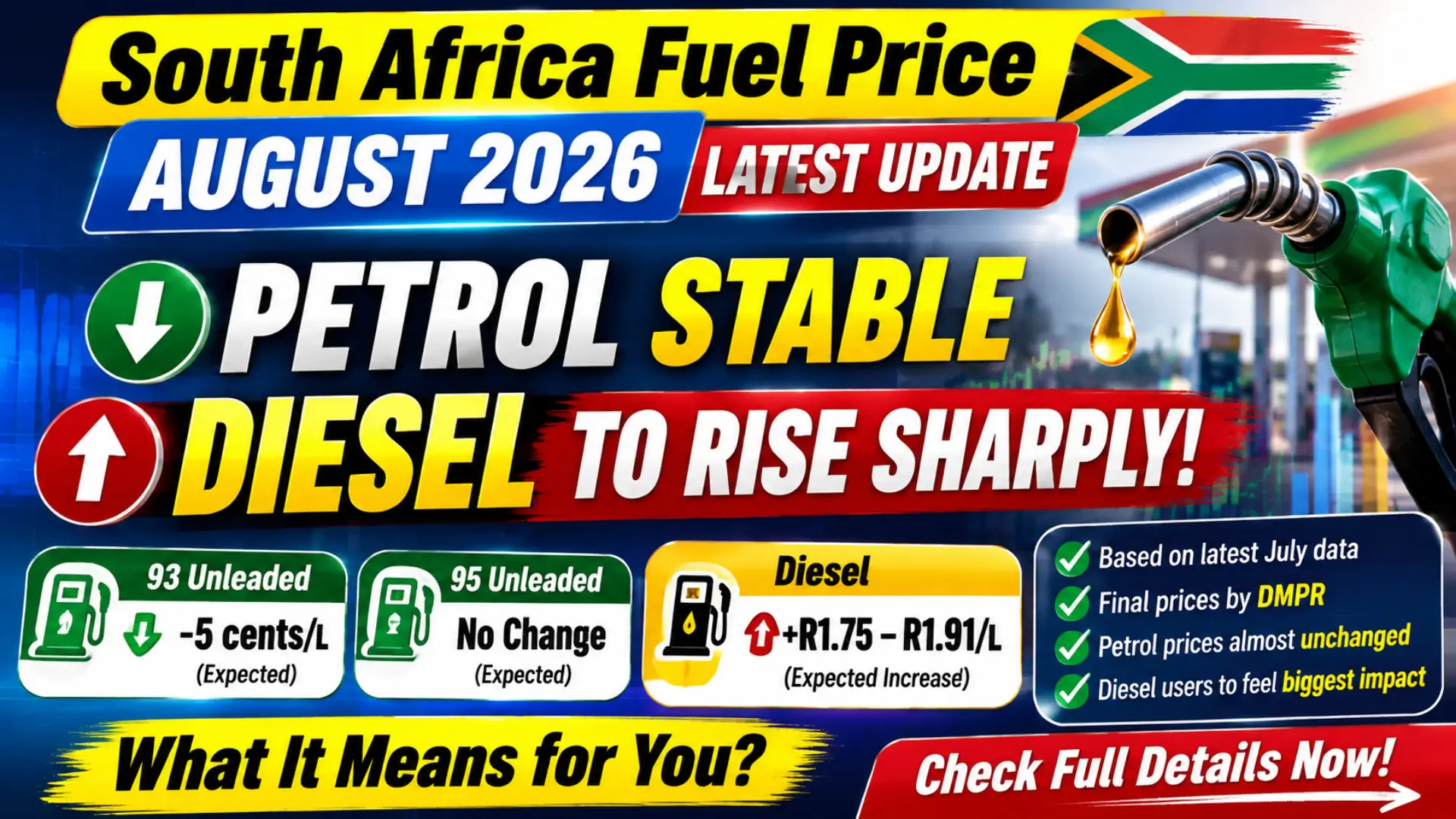
South African motorists are likely to experience a mixed fuel price adjustment in August 2026. Current data indicates that petrol prices are expected to remain almost unchanged, while diesel users could face one of the biggest monthly increases this year. The latest fuel outlook is based on end-of-July pricing data and international oil market movements.
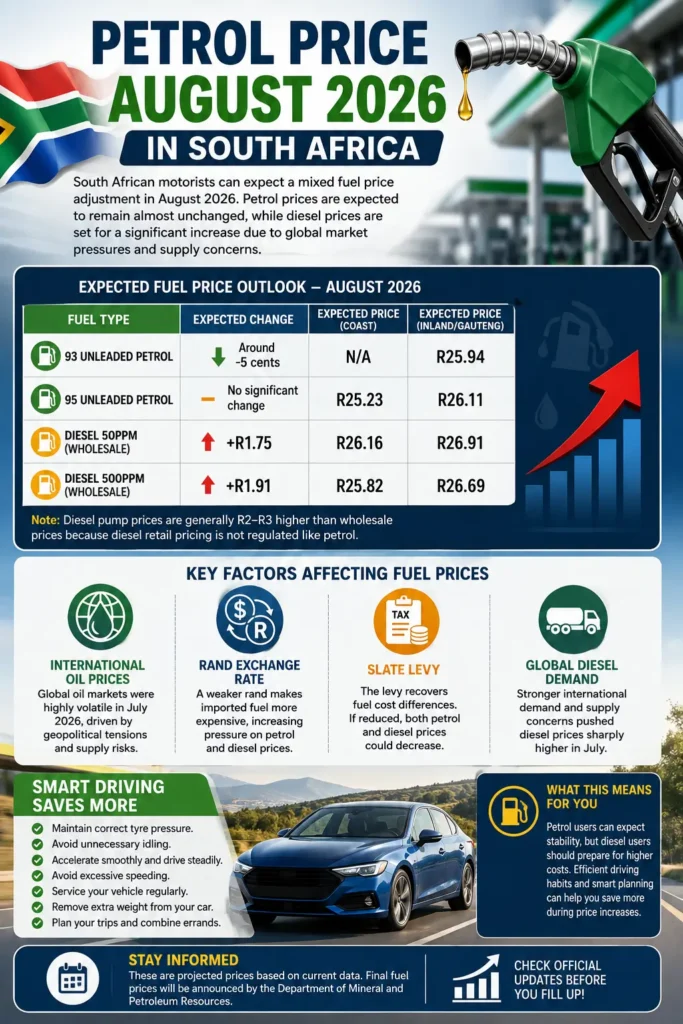
Although the final prices will only be confirmed by the Department of Mineral and Petroleum Resources, the latest projections provide a strong indication of what consumers can expect. Factors such as global oil prices, the rand-dollar exchange rate, and the Slate Levy will continue to determine the final outcome.
Petrol Price August 2026 in South Africa – Latest Update
According to the latest available fuel pricing outlook, petrol prices are expected to remain largely stable during August 2026. Current projections suggest a small decrease of around 5 cents per litre for 93 Unleaded, while 95 Unleaded is expected to remain unchanged.
You can also read: SASSA Payment Status 2026 — Full Guide
Diesel tells a different story. International diesel prices increased significantly during July, pushing expected wholesale diesel prices much higher. Transport companies, farmers, logistics businesses, and diesel vehicle owners are likely to feel the biggest impact from this month’s adjustment.
Expected Petrol and Diesel Prices for August 2026
The following projections reflect current expectations before the official monthly announcement.
| Fuel Type | Expected Change | Expected Price (Coast) | Expected Price (Inland/Gauteng) |
|---|---|---|---|
| 93 Unleaded Petrol | Around -5 cents | N/A | R25.94 |
| 95 Unleaded Petrol | No significant change | R25.23 | R26.11 |
| Diesel 50ppm (Wholesale) | +R1.75 | R26.16 | R26.91 |
| Diesel 500ppm (Wholesale) | +R1.91 | R25.82 | R26.69 |
Note: Diesel pump prices are generally R2–R3 higher than wholesale prices because diesel retail pricing is not regulated like petrol.
Why Petrol Prices Are Staying Stable While Diesel Is Rising
Petrol and diesel are priced differently because each fuel responds to separate international refined fuel markets. While crude oil influences both fuels, supply and demand for refined diesel products have been much stronger during July.
Several factors contributed to diesel’s larger increase:
- Higher international diesel product prices
- Increased global transport demand
- Supply concerns linked to geopolitical tensions
- Shipping risks affecting fuel distribution
- Market uncertainty throughout July
Petrol prices remained relatively balanced because international petrol prices did not rise as sharply during the same period.
International Oil Prices Continue to Create Uncertainty
Global oil markets experienced exceptional volatility throughout July 2026. Brent crude started the month near $72 per barrel, but rising geopolitical tensions in the Middle East pushed prices sharply higher.
Concerns surrounding potential disruptions through the Strait of Hormuz caused traders to anticipate supply shortages. Although oil prices later eased as diplomatic efforts reduced market fears, volatility remained high and continues to influence fuel price calculations for South Africa.
How the Rand Exchange Rate Affects Fuel Prices
South Africa imports a significant portion of its fuel requirements, making the exchange rate an important part of monthly fuel calculations.
A weaker rand generally results in:
- More expensive imported fuel
- Higher transport costs
- Increased wholesale fuel prices
- Greater pressure on diesel and petrol prices
A stronger rand, however, can help offset rising international oil prices and reduce pressure on domestic fuel costs.
Understanding the Slate Levy
The Slate Levy is one of the most important components of South Africa’s fuel pricing system, yet many motorists are unaware of its purpose.
The levy helps recover under-recoveries or over-recoveries experienced by fuel companies because fuel is purchased continuously throughout the month rather than only when monthly fuel prices are adjusted.
If the current R1.14 per litre Slate Levy is reduced:
- Petrol prices could decrease more than expected.
- Diesel increases could become smaller.
- Consumers would benefit from lower pump prices.
However, there is no guarantee that the levy will change during August.
What This Means for South African Motorists
Most petrol vehicle owners are unlikely to notice any significant difference at the pumps during August. Diesel users, however, should prepare for considerably higher fuel expenses if current projections become official.
You can also read: SRD SASSA Status Check
Businesses that rely heavily on diesel-powered vehicles may also experience increased operating costs, which can indirectly influence transport charges and product prices across the economy.
Practical Ways to Save Fuel During Price Increases
Even when fuel prices rise, small driving habits can make a noticeable difference.
- Maintain correct tyre pressure.
- Avoid unnecessary idling.
- Accelerate smoothly.
- Reduce excessive speeding.
- Remove unnecessary weight from the vehicle.
- Service your engine regularly.
- Combine multiple errands into one trip.
- Use cruise control on highways where appropriate.
These simple habits can improve fuel efficiency regardless of monthly price changes.
Common Mistakes Drivers Make
Many motorists unintentionally increase their fuel expenses through poor driving habits.
Common mistakes include:
- Waiting until the fuel tank is almost empty before refuelling.
- Ignoring tyre maintenance.
- Carrying unnecessary heavy items.
- Delaying regular vehicle servicing.
- Aggressive acceleration and braking.
- Assuming all filling stations offer identical prices for diesel.
Avoiding these mistakes can help reduce monthly fuel costs.
Frequently Asked Questions
Will petrol prices increase in August 2026?
Current projections indicate that petrol prices are expected to remain almost unchanged, with only a slight reduction expected for 93 Unleaded.
Why is diesel increasing so much?
Diesel prices are rising mainly because international diesel product prices increased sharply during July, combined with global supply concerns.
Are these the final fuel prices?
No. These are projected prices based on the latest available data. The Department of Mineral and Petroleum Resources will announce the official fuel prices.
What is the Slate Levy?
The Slate Levy is a pricing mechanism used to recover fuel cost differences experienced by fuel suppliers due to fluctuations in international oil prices and exchange rates.
Can fuel prices still change before implementation?
Yes. Any last-minute adjustments to the Slate Levy or significant market movements before the official announcement could affect the final prices.
You can also read: SRD SASSA Status Check Online
Conclusion
The Petrol Price August 2026 in South Africa outlook shows relatively positive news for petrol users, with prices expected to remain stable after months of market uncertainty. Diesel users, however, are likely to face a substantial increase driven by higher international refined fuel prices and ongoing global supply concerns.
Motorists should remember that these figures remain projections until the official announcement is released. The final adjustment will largely depend on the Department of Mineral and Petroleum Resources’ monthly pricing decision and any changes made to the Slate Levy. Until then, maintaining efficient driving habits and monitoring official fuel price updates remain the best ways to manage fuel expenses during August 2026.