NSFAS Releases R621m Allowances to Over 200 000 TVET Students In South Africa

The National Student Financial Aid Scheme (NSFAS) has successfully released April 2026 allowances to more than 200,000 Technical and Vocational Education and Training (TVET) students across South Africa. This major disbursement highlights the scheme’s ongoing commitment to ensuring financial stability for students who depend on funding to continue their education.
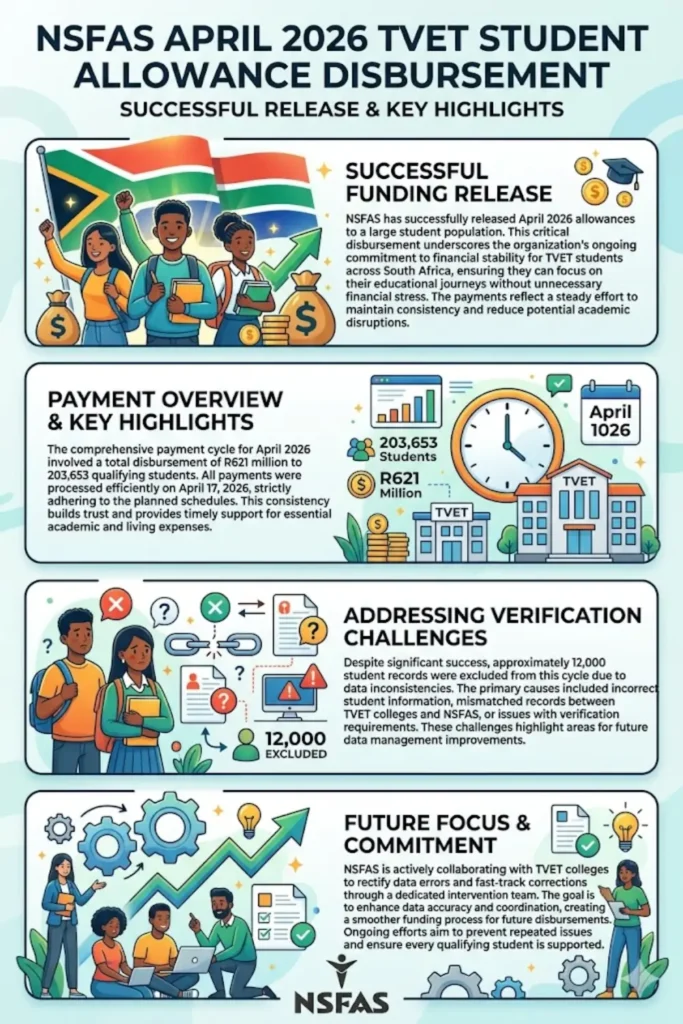
Timely financial support is critical for students enrolled in TVET colleges, as many rely on these allowances to cover basic living and academic expenses. The latest payment reflects NSFAS’s effort to maintain consistency and reduce disruptions in the academic journey of funded students.
You can also read: How to Check SRD Application ID Information
Details of the April 2026 Payment
In April 2026, NSFAS disbursed a total of R621 million to qualifying TVET students. The payments were processed on April 17, following the planned schedule set by the organization.
A total of 203,653 students benefited from this payment cycle, which ensured that a large portion of the student population received their funds without delay. This consistency plays a vital role in maintaining trust between students and the funding body.
Key Highlights of the Payment
- Over 203,000 students received allowances
- Total disbursement reached R621 million
- Payments were completed on April 17, 2026
- Process followed planned timelines without major delays
Why NSFAS Funding Matters for TVET Students
NSFAS funding is essential for thousands of students pursuing vocational education in South Africa. These funds are not just financial support they are a lifeline that enables students to stay enrolled and focused on their studies.
For many students, the allowance helps cover:
- Accommodation and transport costs
- Food and daily living expenses
- Study materials and academic resources
Without this support, many students would struggle to continue their education, leading to higher dropout rates and reduced opportunities for skill development.
Challenges in the Payment Process
Despite the successful disbursement, not all students received their allowances. NSFAS reported that approximately 12,000 student records were excluded from this payment cycle due to verification issues.
These exclusions were mainly caused by inconsistencies in the data shared between NSFAS and TVET colleges. Such discrepancies can delay payments and create uncertainty for affected students.
Common Reasons for Exclusion
- Incorrect or incomplete student data
- Mismatched records between institutions
- Failure to meet verification requirements
- Delays in data submission by colleges
You can also read: How to Check Sassa E-Life Certification Portal Online
Steps Taken to Resolve Payment Issues
To address these challenges, NSFAS has taken proactive steps to ensure that affected students are not permanently excluded from receiving their allowances.
The organization has shared the list of affected students with respective colleges and is working closely with them to correct the errors. A dedicated intervention team has also been deployed to speed up the resolution process.
Actions Being Implemented
- Collaboration with TVET colleges to fix data errors
- Verification of student eligibility records
- Fast-tracking corrections through a special intervention team
- Monitoring future submissions to prevent repeated issues
Breakdown of NSFAS Disbursement
Below is a simple overview of the April 2026 payment distribution:
| Category | Details |
|---|---|
| Total Students Paid | 203,653 |
| Total Amount Disbursed | R621 million |
| Payment Date | April 17, 2026 |
| Students Excluded | حوالي 12,000 |
| Reason for Exclusion | Data inconsistencies |
This table highlights the scale of the disbursement and the portion of students affected by verification challenges.
How Colleges and Students Can Avoid Delays
To prevent similar issues in future payment cycles, both institutions and students need to play an active role in ensuring accurate data submission.
Students should regularly check their information and ensure all required documents are submitted correctly. At the same time, colleges must improve their data management processes.
Tips to Avoid Payment Delays
- Double-check personal and academic information
- Submit all required documents on time
- Maintain regular communication with college administration
- Ensure data submitted to NSFAS is accurate and updated
NSFAS Commitment to Improvement
NSFAS has reaffirmed its commitment to improving payment efficiency and ensuring that all qualifying students receive their allowances on time. The organization is focusing on strengthening data accuracy and enhancing coordination with TVET colleges.
By addressing current challenges and implementing better systems, NSFAS aims to create a smoother and more reliable funding process for future disbursements.
You can also read: How to Cancel NSFAS to Receive an SRD Grant
Conclusion
The release of R621 million to over 200,000 TVET students marks a significant achievement for NSFAS in maintaining funding stability. While challenges remain, especially for the 12,000 students affected by verification issues, ongoing efforts to resolve these problems show a clear commitment to improvement.
With better collaboration between NSFAS and educational institutions, future payment cycles are expected to become more efficient, ensuring that no deserving student is left behind.