NSFAS Funding Under Scrutiny as More Than 40,000 Students Were Improperly Funded
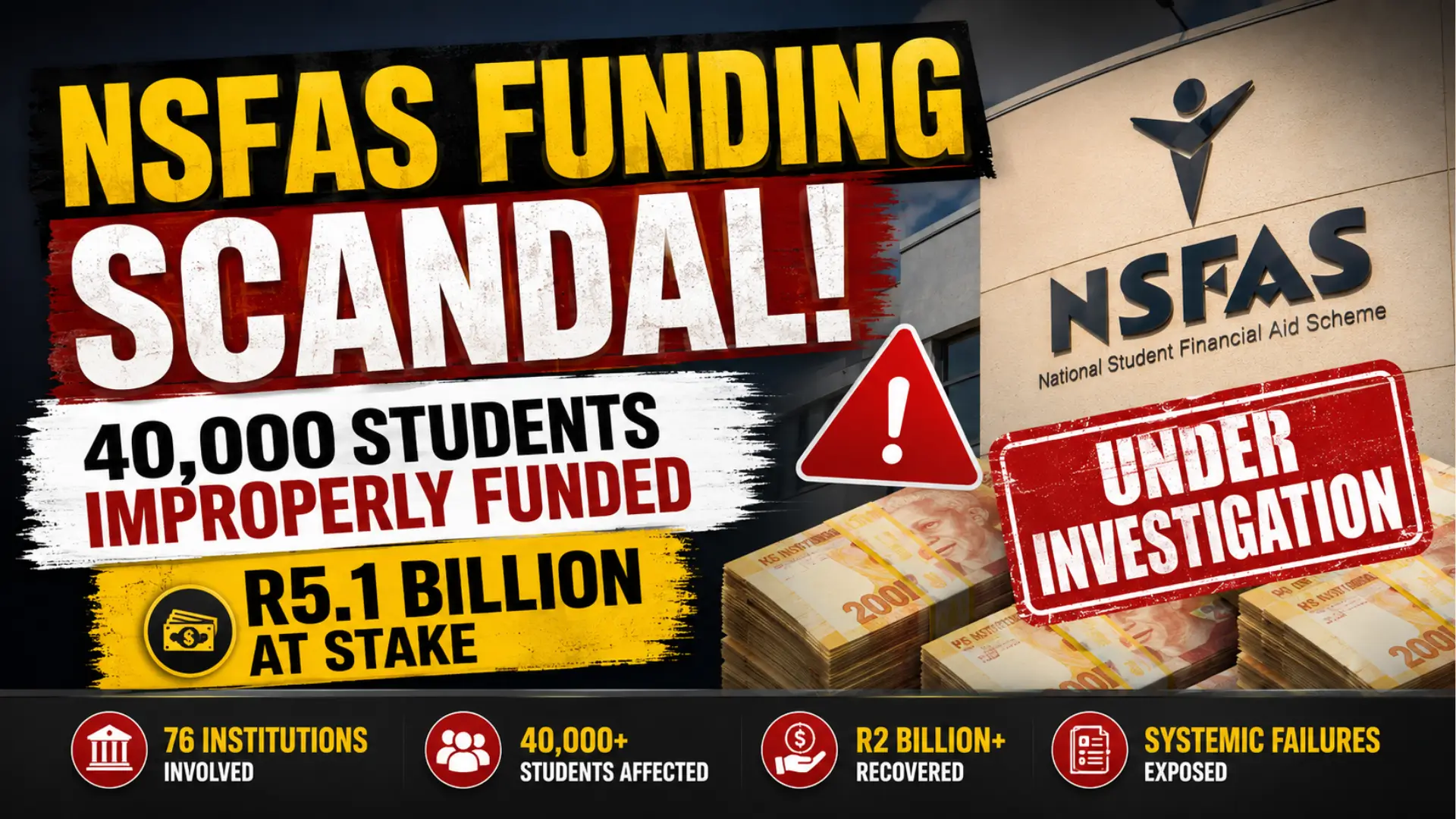
The National Student Financial Aid Scheme (NSFAS) is facing renewed scrutiny over serious concerns about the way student funding has been administered. An investigation into the scheme found that more than 40,000 students were improperly funded, with the value of the funding estimated at about R5.1 billion.
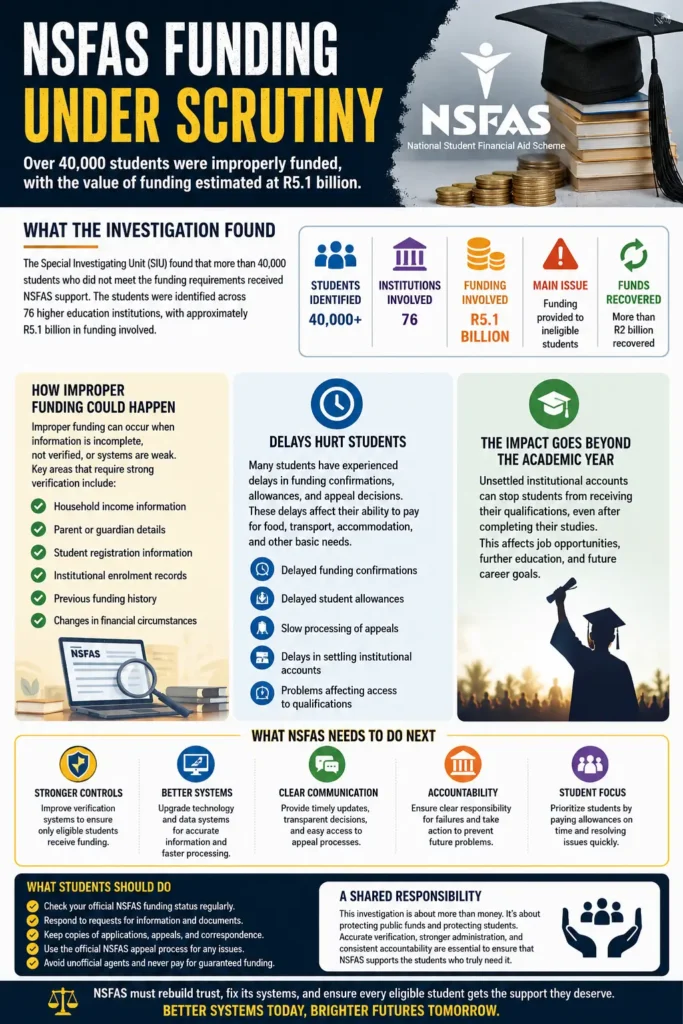
The issue is significant because NSFAS is designed to help students who cannot afford higher education. When funding is incorrectly allocated, it can put pressure on a limited public budget and potentially affect students who genuinely depend on financial aid to study, pay for accommodation and meet basic living costs.
NSFAS Improper Funding: What the Investigation Found
The concerns stem from investigations into NSFAS funding and allegations of maladministration. Information presented by the Special Investigating Unit (SIU) to Parliament showed that more than 40,000 students who did not meet the funding requirements had received NSFAS support. Earlier SIU findings placed the value involved at approximately R5.1 billion.
You can also read: SRD SC19 and How Apply SASSA
The students were identified across 76 higher education institutions. The investigation focused, among other things, on whether students met the applicable household-income requirements and whether the information used to assess applications was properly verified.
| Key issue | Reported finding |
|---|---|
| Students identified | More than 40,000 |
| Institutions involved | 76 higher education institutions |
| Funding involved | Approximately R5.1 billion |
| Main concern | Funding provided to students who were not eligible |
| Investigation | SIU investigation under Proclamation R88 of 2022 |
| Recovery efforts | More than R2 billion reported as recovered |
Why R5.1 Billion in NSFAS Funding Matters
R5.1 billion is a substantial amount of public money. The concern is not simply that individual students received funding incorrectly. It also raises questions about the controls used by NSFAS to verify applications, assess household income and ensure that payments are made to eligible beneficiaries.
Earlier reporting on the SIU investigation found weaknesses in NSFAS information technology and financial systems. These weaknesses were linked to problems including incorrect payments, overpayments and funding being provided to students who did not qualify.
More Than 40,000 Students Were Identified Across 76 Institutions
The scale of the problem makes the investigation particularly important. The students were not concentrated at one university or college. The investigation covered 76 higher education institutions, indicating that the problem could not simply be treated as an isolated administrative mistake at a single institution.
The SIU previously reported that some students had household incomes above the NSFAS threshold but had not provided complete parental information when applying. This meant that the means test could not always be properly conducted.
How Improper Funding Could Happen
Several weaknesses can contribute to incorrect funding decisions. These may include incomplete application information, difficulties verifying household circumstances and weaknesses in the systems used to match student information with government records.
Important areas that require strong verification include:
- Household income information
- Parent or guardian details
- Student registration information
- Institutional enrolment records
- Previous funding history
- Changes in a student’s financial circumstances
Strong verification is essential because NSFAS resources are intended for students who meet the applicable funding rules.
You can also read: How to Apply for SASSA R350 Online 2026
More Than R2 Billion Has Been Recovered
The recovery of money is another important part of the NSFAS investigation. More than R2 billion of the funds connected to the improper funding has reportedly been recovered, reducing the amount of public money that remains outstanding.
However, recovering money does not by itself resolve the underlying administrative problems. The bigger question is why the incorrect payments happened and whether the controls responsible for preventing similar cases have been strengthened.
Public Protector Raises Wider NSFAS Concerns
The concerns surrounding NSFAS extend beyond students who were improperly funded. Public Protector Kholeka Gcaleka’s investigation also highlighted broader administrative problems affecting students who depend on the scheme.
The findings point to possible systemic maladministration when the investigation’s evidence is considered alongside complaints from students, stakeholder engagements and other oversight findings. This is important because NSFAS is expected to provide reliable financial support at a time when students are already dealing with tuition, accommodation and living costs.
Students Have Faced Delays in Funding and Allowances
One of the most visible problems for students has been delays. Students have reported waiting for confirmation of their funding status, allowances and decisions on appeals.
Delays can have immediate consequences. A student who does not receive an allowance on time may struggle to pay for food, transport or accommodation. At the institutional level, delayed payments can also create outstanding balances between NSFAS and universities or colleges.
The reported problems include:
- Delayed funding confirmations
- Delayed student allowances
- Slow processing of appeals
- Delays in settling institutional accounts
- Problems affecting students’ access to qualifications
Some Students Have Been Affected Even After Completing Their Studies
The consequences can continue beyond the academic year. When an institution’s account remains unsettled, students can face difficulties obtaining their qualifications or completing administrative processes linked to graduation.
This is particularly serious for students who have already completed their academic requirements. A qualification is often needed to apply for employment, professional opportunities or further education, so administrative delays can have effects long after the original funding problem occurred.
The issue therefore goes beyond accounting. Reliable payment and accurate student records can directly affect a student’s academic progression and future opportunities.
NSFAS Has Faced a Long-Running Governance Crisis
The latest concerns are not completely new. Independent reviews have previously raised questions about NSFAS administration. The 2021 Ministerial Committee of Enquiry, for example, described the organisation as operating in what was effectively a near-permanent state of crisis.
This history matters because repeated administrative problems suggest that the challenge is not simply one delayed payment or one incorrect application. Sustainable improvement requires stronger governance, better technology, reliable data and effective oversight.
Why Systemic Problems Are More Serious
A system can make occasional mistakes without being fundamentally broken. Systemic maladministration is different because weaknesses can repeatedly produce similar problems across different groups of students and institutions.
For NSFAS, the most important areas for improvement include:
- Accurate student and household verification
- Reliable information technology systems
- Faster application processing
- Transparent appeal procedures
- Timely payment of allowances
- Accurate reconciliation with institutions
- Stronger financial controls
- Clear accountability for administrative failures
You can also read: Sassa Status Check SC19 & Check SASSA
What This Means for NSFAS Students
Students should not assume that the investigation means every NSFAS beneficiary is affected or that legitimate funding will automatically be cancelled. The findings concern students identified as having been improperly funded, while many other students remain legitimate beneficiaries of the scheme.
Students who depend on NSFAS should continue checking their official funding status and responding to requests for information. They should also keep copies of application records, appeal submissions and relevant correspondence.
If a funding decision appears incorrect, the student should use the official NSFAS appeal or enquiry process rather than relying on social media claims or unofficial agents.
Common Mistakes Students Should Avoid
NSFAS-related problems can become more difficult when students rely on inaccurate information. A student should never pay an unofficial person who promises to approve an application, change a funding decision or speed up an appeal.
Students should also avoid submitting information that cannot be verified. Incorrect household or registration information can create problems during eligibility checks and may result in funding being reviewed or withdrawn.
Key mistakes to avoid include:
- Giving false information on an application
- Ignoring requests for supporting documents
- Relying on unofficial NSFAS payment information
- Paying people who promise guaranteed funding
- Failing to monitor an appeal
- Assuming a funding status cannot change
What NSFAS Needs to Do Next
The immediate priority should be improving the controls that determine who receives funding. Recovering improperly allocated money is important, but preventing future incorrect payments is equally important.
NSFAS also needs to improve communication with students and institutions. Clear funding decisions, timely appeals and predictable payment processes can reduce uncertainty and prevent administrative problems from turning into academic crises.
The organisation’s technology and data systems are especially important. Previous investigations identified weaknesses in ICT systems that contributed to payment and verification problems, showing why technological reform needs to be treated as a core governance issue rather than a secondary administrative project.
NSFAS Funding Under Scrutiny: What Happens Next?
The investigation places significant pressure on NSFAS to demonstrate that its funding controls are working effectively. The reported recovery of more than R2 billion shows that efforts have been made to recover money, but the larger challenge is restoring confidence in the entire funding process.
For students, the most important outcome should be a system that identifies eligible applicants accurately, pays allowances on time and resolves appeals without unnecessary delays. For government and taxpayers, the priority is ensuring that billions of rand allocated for student financial aid reach the students who qualify.
The NSFAS controversy therefore highlights two connected responsibilities: protecting public funds and protecting students. Both require accurate verification, stronger administration, transparent decision-making and consistent accountability.
FAQs
How many students were improperly funded by NSFAS?
More than 40,000 students were identified in investigations into improper NSFAS funding. Earlier SIU findings indicated that the students were spread across 76 higher education institutions.
How much NSFAS money was involved?
The investigation identified approximately R5.1 billion in funding provided to students who were considered ineligible under the relevant funding requirements.
Has any of the NSFAS money been recovered?
Yes. More than R2 billion has reportedly been recovered as part of efforts to address improper funding and recover amounts owed to NSFAS.
Does this mean all NSFAS students will lose their funding?
No. The investigation concerns students identified as improperly funded. Legitimate students should continue following their normal NSFAS funding requirements and check their official status.
Why is NSFAS facing criticism beyond improper funding?
The concerns also include delays in funding decisions, student allowances, appeals and payments to higher education institutions. These administrative problems can have serious consequences for students.
What should students do if their NSFAS funding is delayed?
Students should check their official NSFAS funding status, follow up through the appropriate support channels and submit an appeal when they believe a funding decision is incorrect. They should keep records of applications, documents and correspondence.
Conclusion
The NSFAS funding controversy is about more than the R5.1 billion figure. It raises broader questions about verification, governance, technology, accountability and the ability of the student funding system to provide support when students need it most.
The identification of more than 40,000 improperly funded students across 76 institutions demonstrates the scale of the challenge. At the same time, the recovery of more than R2 billion shows that efforts are being made to address the financial impact. The long-term test, however, will be whether NSFAS can strengthen its systems sufficiently to prevent similar failures and ensure that deserving students receive accurate and timely financial support.