Employment Services Amendment Bill Fines Details Step by Step

The Employment Services Amendment Bill is a proposed law in South Africa designed to strengthen enforcement against the employment of undocumented foreign nationals. The bill was gazetted on 26 May after receiving Cabinet approval and is now part of broader government efforts to address illegal immigration and improve compliance with employment regulations.
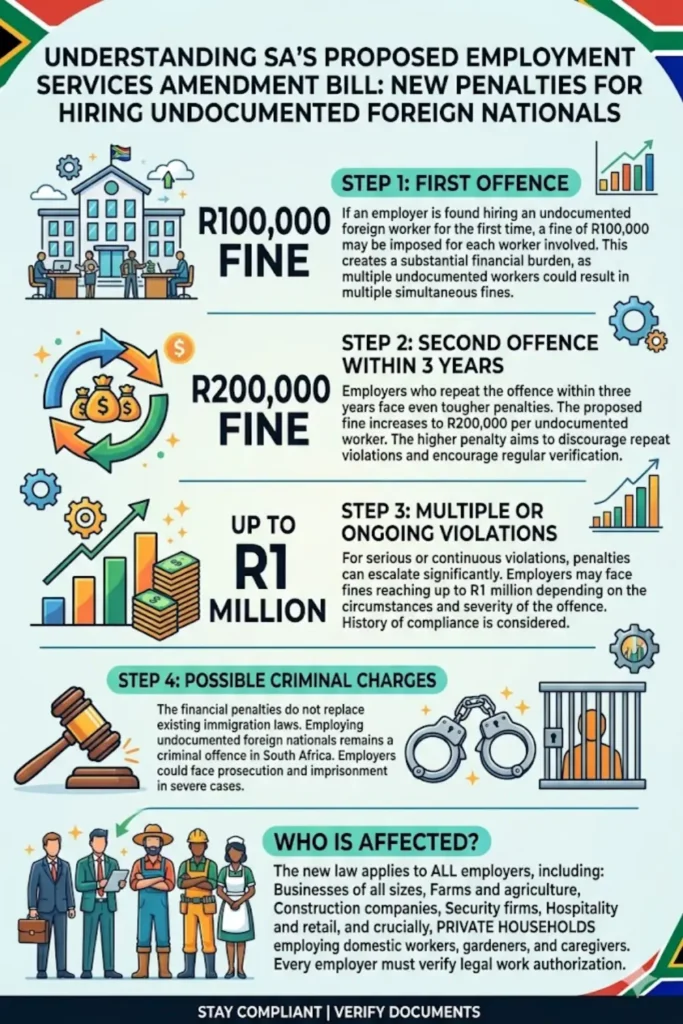
One of the biggest changes introduced by the bill is the significant increase in fines for employers who hire foreign workers without valid work authorization. The law applies not only to businesses but also to private households that employ domestic workers, gardeners, caregivers, and other household staff.
Why the Government Introduced the New Employment Penalties
The government says the amendments are intended to close loopholes in existing employment laws and ensure that employers properly verify the legal status of foreign workers before hiring them. Authorities also believe the changes will help prioritize employment opportunities for South African citizens.
You can also read: South Africa Immigration Backlash
At the same time, the proposed legislation aims to improve accountability among employers. Instead of relying solely on immigration authorities, the bill places a clear responsibility on employers to verify that foreign employees have valid documentation and legal permission to work in South Africa.
Employment Services Amendment Bill Fines
The bill introduces a progressive penalty system that becomes more severe for repeat offenders. Employers who continue violating employment laws may face increasingly expensive fines and potential criminal consequences.
Step 1: First Offence
If an employer is found hiring an undocumented foreign worker for the first time, a fine of R100,000 may be imposed for each worker involved.
This means that employing multiple undocumented workers could result in multiple fines being issued simultaneously, creating a substantial financial burden.
Step 2: Second Offence Within Three Years
Employers who repeat the offence within three years face even tougher penalties. The proposed fine increases to R200,000 per undocumented worker.
The higher penalty is intended to discourage repeat violations and encourage employers to regularly verify employee documentation.
Step 3: Multiple or Ongoing Violations
For serious or continuous violations, penalties can escalate significantly. Employers may face fines reaching up to R1 million depending on the circumstances and severity of the offence.
Authorities may also consider the employer’s history of compliance when determining the appropriate penalty.
Step 4: Possible Criminal Charges
The financial penalties do not replace existing immigration laws. Employing undocumented foreign nationals remains a criminal offence under South Africa’s Immigration Act.
In severe cases, employers could face criminal prosecution and possible imprisonment in addition to administrative fines.
Employment Services Amendment Bill Fine Structure
| Offence Level | Proposed Fine |
|---|---|
| First Offence | R100,000 per undocumented worker |
| Second Offence Within 3 Years | R200,000 per undocumented worker |
| Multiple or Repeated Violations | Up to R1 million |
| Serious Criminal Violations | Possible imprisonment and additional penalties |
Who Will Be Affected by the New Law?
The proposed legislation covers a wide range of employers throughout South Africa. Many people mistakenly believe the law only targets large businesses, but private households are also included.
The following employers may be affected:
- Private households employing domestic workers
- Businesses of all sizes
- Farms and agricultural employers
- Construction companies
- Security firms
- Hospitality businesses
- Retail employers
- Caregivers and household support staff employers
Every employer has a responsibility to verify legal work authorization before hiring foreign nationals.
What Documents Employers Should Verify
Before employing a foreign national, employers should carefully review all required documentation. Proper verification can help avoid costly penalties and legal complications.
Important documents may include:
- Valid passport
- Work visa
- Employment permit
- Exemption permit where applicable
- Temporary residence permit
- Any government-issued authorization allowing employment
Employers should keep copies of verified documents and regularly check expiry dates.
Domestic Workers and Household Employers: What You Need to Know
One of the most significant aspects of the amendment bill is that it applies directly to households. Homeowners who hire domestic workers are expected to conduct the same legal checks as commercial employers.
Many households have traditionally relied on informal hiring arrangements. However, under the proposed framework, failing to verify a domestic worker’s legal status could expose homeowners to substantial financial penalties.
You can also read: South Africa Petrol Price Hikes June
Are All Foreign Domestic Workers Illegal?
No. Migration experts emphasize that many foreign nationals living and working in South Africa are legally authorized to work. Holding foreign citizenship does not automatically mean a worker is undocumented.
Certain permit holders, including individuals covered by specific exemption permit programs, may legally work in South Africa until the validity of their permits expires. Employers should assess each worker’s documentation individually rather than making assumptions based on nationality.
Common Employer Mistakes That Can Lead to Fines
Many violations occur because employers fail to conduct proper checks rather than intentionally breaking the law.
Common mistakes include:
- Not requesting work authorization documents
- Failing to verify permit expiry dates
- Assuming a passport alone grants work rights
- Hiring workers through informal referrals without checks
- Not keeping copies of employment records
- Ignoring documentation renewal requirements
Avoiding these mistakes can significantly reduce legal risk.
Best Practices for Employers
Employers can take several practical steps to remain compliant with employment and immigration regulations.
Recommended best practices include:
- Verify all documents before employment begins
- Keep secure records of employee documents
- Review permits regularly
- Update employee files when permits are renewed
- Use written employment contracts
- Seek legal advice when documentation is unclear
- Monitor changes in immigration and labour laws
Regular compliance reviews can prevent expensive penalties later.
What Experts Are Saying About the Bill
Migration and labour experts have raised concerns about the broader employment challenges affecting both South African and foreign workers. They argue that poor working conditions, informal employment arrangements, and limited access to legal documentation remain major issues in the domestic work sector.
Experts also note that available research does not conclusively show that foreign nationals are broadly displacing South African workers. Instead, many migrants often accept difficult working conditions because they are seeking economic opportunities and stability.
Latest Update on the Employment Services Amendment Bill
The Employment Services Amendment Bill has been gazetted and approved by Cabinet for introduction to Parliament. However, it must still complete the legislative process before becoming law.
Employers should monitor official government announcements and begin reviewing employment records now so they are prepared for any future implementation of the new penalties.
You can also read: Declined SRD SASSA Status 2026
Final Thoughts
The Employment Services Amendment Bill introduces some of the toughest proposed penalties yet for employers who hire undocumented foreign workers in South Africa. With fines starting at R100,000 per worker and potentially rising to R1 million, both businesses and households face significant compliance responsibilities.
The safest approach is to verify documentation carefully, maintain accurate employment records, and ensure every foreign employee has the legal right to work. Taking these steps now can help employers avoid costly fines, legal disputes, and potential criminal consequences in the future.