South Africa Diesel Price Drop Rand Stability Offers Partial Offset

South African motorists are heading into June with mixed fuel price expectations. While petrol prices are expected to rise slightly, diesel users could finally see meaningful relief after months of pressure. The latest projections from the Central Energy Fund (CEF) show that global oil price recoveries have improved, helping diesel prices move lower.
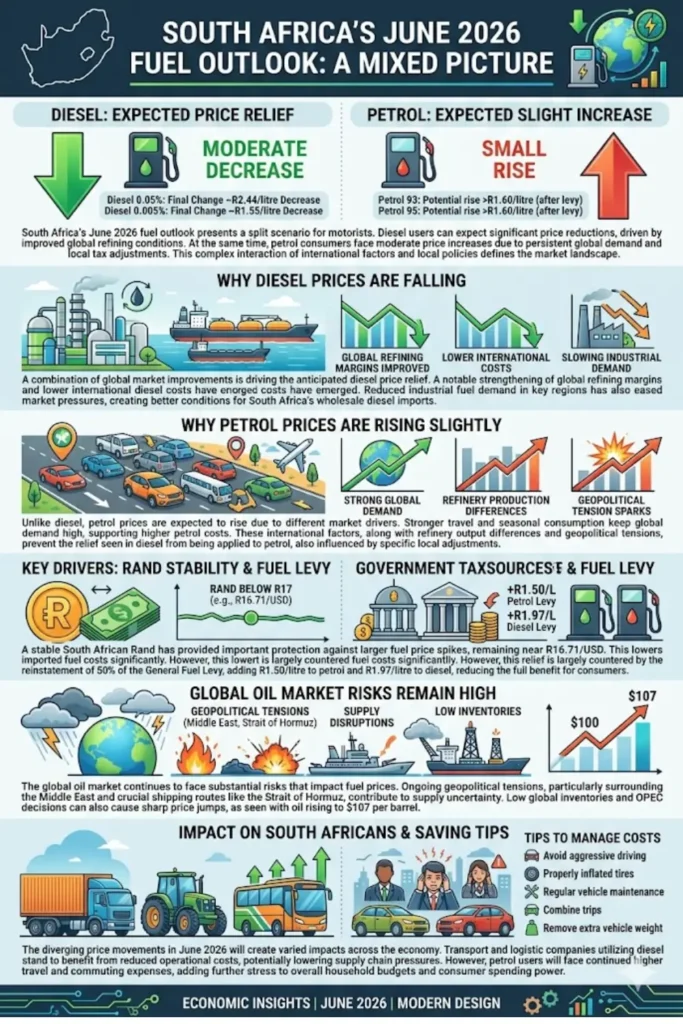
At the same time, the stronger rand has played an important role in reducing imported fuel costs. However, despite these improvements, the return of the General Fuel Levy (GFL) means consumers may not fully benefit from lower international oil prices. This combination of global and local factors is creating a complicated fuel price picture for June 2026.
Why Diesel Prices Are Falling in June
Diesel prices are expected to decrease mainly because of improved global refining margins and reduced international diesel costs. Recent market data shows that diesel recoveries have strengthened significantly compared to earlier months when global supply concerns pushed prices higher.
You can also read: South Africa Electricity Price
Another major factor is slowing industrial fuel demand in some global regions, which has eased pressure on diesel markets. This has created better pricing conditions for South Africa’s wholesale diesel imports, allowing local price recoveries to improve.
Expected Diesel Price Reductions
| Fuel Type | Expected Change Before Levy | Estimated Final Change |
|---|---|---|
| Diesel 0.05% | Decrease of up to R4.41/litre | Decrease of around R2.44/litre |
| Diesel 0.005% | Decrease of around R3.52/litre | Decrease of around R1.55/litre |
Although the levy adjustment reduces some of the savings, diesel users are still expected to benefit more than petrol motorists in June.
Petrol Prices Expected to Rise Slightly
Petrol prices are projected to increase modestly despite recent improvements in fuel recoveries. Petrol 93 may rise by approximately 13 cents per litre, while Petrol 95 could increase by around 19 cents per litre before tax adjustments are applied.
The main reason petrol is not seeing the same relief as diesel is because global petrol demand remains relatively strong. Travel activity, seasonal consumption, and refinery output differences continue to support higher petrol prices internationally.
Key Petrol Price Factors
- Continued global demand for petrol products
- Geopolitical instability affecting crude oil supply
- Refinery production imbalances
- Fuel levy increases in South Africa
- Exchange rate movements between the rand and US dollar
Once the levy increase is included, petrol prices could effectively rise by more than R1.60 per litre in June.
How Rand Stability Is Helping Fuel Prices
One positive development for South Africa is the relatively stable performance of the rand. The currency has remained below R17 against the US dollar and recently traded near R16.71/USD, helping reduce pressure on imported fuel costs.
Since South Africa imports large amounts of refined fuel and crude oil, a stronger rand directly lowers the cost of fuel purchases in local currency terms. Without rand stability, fuel prices would likely have increased much more sharply.
Benefits of a Stronger Rand
- Reduces imported fuel costs
- Helps stabilise inflation pressures
- Limits large fuel price shocks
- Supports transport and logistics sectors
- Helps businesses manage operating expenses
Even though the rand has offered some protection, it has not been enough to completely cancel out global oil volatility and local tax increases.
Global Oil Market Risks Still Remain
Global oil markets remain highly unpredictable due to ongoing geopolitical tensions and supply concerns. The Strait of Hormuz continues to be one of the biggest risk zones because any disruption there can immediately affect global oil supply chains.
In addition, limited progress in US-Iran negotiations and periodic regional conflicts have created uncertainty across energy markets. Oil prices have already shown sharp movements recently, jumping from around $100 per barrel to $107 after renewed tensions.
Major Global Risks Affecting Fuel Prices
- Geopolitical tensions in the Middle East
- Supply disruptions in major shipping routes
- Falling global oil inventories
- OPEC production decisions
- Currency fluctuations in emerging markets
Energy analysts also warn that shrinking oil inventories could keep prices elevated for longer if supply conditions worsen during the second half of 2026.
You can also read: Sassa Status Check sc19 Appeal 2026
Impact of the Fuel Levy Reinstatement
One of the biggest reasons consumers are not receiving full relief is the return of the General Fuel Levy. Earlier temporary reductions introduced by the government helped ease pressure on motorists, but Treasury is now reinstating 50% of the levy from June.
This policy adjustment adds approximately R1.50 per litre to petrol and R1.97 per litre to diesel. As a result, much of the benefit from improved fuel recoveries is being offset before prices reach consumers.
How the Levy Changes Final Prices
| Fuel Type | Levy Increase |
|---|---|
| Petrol | +R1.50/litre |
| Diesel | +R1.97/litre |
This means motorists may still feel financial pressure at the pumps despite improving international market conditions.
What These Fuel Changes Mean for South Africans
The June fuel outlook creates mixed outcomes across different sectors of the economy. Diesel price reductions may benefit transport companies, farmers, logistics operators, and businesses that rely heavily on diesel-powered equipment.
However, petrol users may continue facing higher travel and commuting costs. Since fuel prices affect transport expenses across the economy, consumers could still experience pressure on food prices and household budgets.
Sectors Most Affected
- Transport and logistics companies
- Taxi and ride-hailing operators
- Farmers and agricultural businesses
- Retail delivery services
- Daily commuters using petrol vehicles
Lower diesel costs may slightly reduce supply chain expenses, but the overall impact could remain limited because of levy-related increases.
Tips for Motorists to Manage Rising Fuel Costs
South Africans can still reduce fuel expenses by improving driving habits and vehicle efficiency. Small adjustments often make a noticeable difference over time, especially during periods of volatile fuel prices.
Practical Fuel-Saving Tips
- Avoid aggressive acceleration and speeding
- Keep tyres properly inflated
- Service vehicles regularly
- Combine trips to reduce driving distance
- Remove unnecessary vehicle weight
- Compare fuel prices in different areas when possible
Businesses with large vehicle fleets should also review route planning and fuel consumption monitoring to improve efficiency.
Conclusion
South Africa’s June 2026 fuel outlook reflects a market balancing between positive and negative pressures. Diesel users are expected to receive some welcome relief as global pricing conditions improve, while petrol motorists may continue facing moderate increases.
You can also read: Sassa Digital Queue System
Rand stability has helped soften the impact of global oil volatility, but the reinstatement of the General Fuel Levy has reduced much of the potential savings. Going forward, global geopolitical developments, oil supply conditions, and currency performance will remain critical factors influencing fuel prices across South Africa.