May Fuel Price Higher than Expected: Bigger Fuel Price Crisis Looms in June and July
South Africa is facing a sharp rise in fuel prices this May, with increases exceeding earlier expectations. The latest announcement confirms that both petrol and diesel prices have surged significantly, placing additional financial pressure on households and businesses. While May’s hike is already substantial, early indicators suggest that June and July could bring even steeper increases, raising concerns about a broader fuel price crisis.
This article explores the reasons behind the current increase, what lies ahead, and how it may impact everyday life.
Overview of May Fuel Price Increase
The latest fuel price adjustment has taken many consumers by surprise. Petrol and diesel prices have risen far more than initial forecasts, mainly due to global oil trends and local pricing mechanisms.
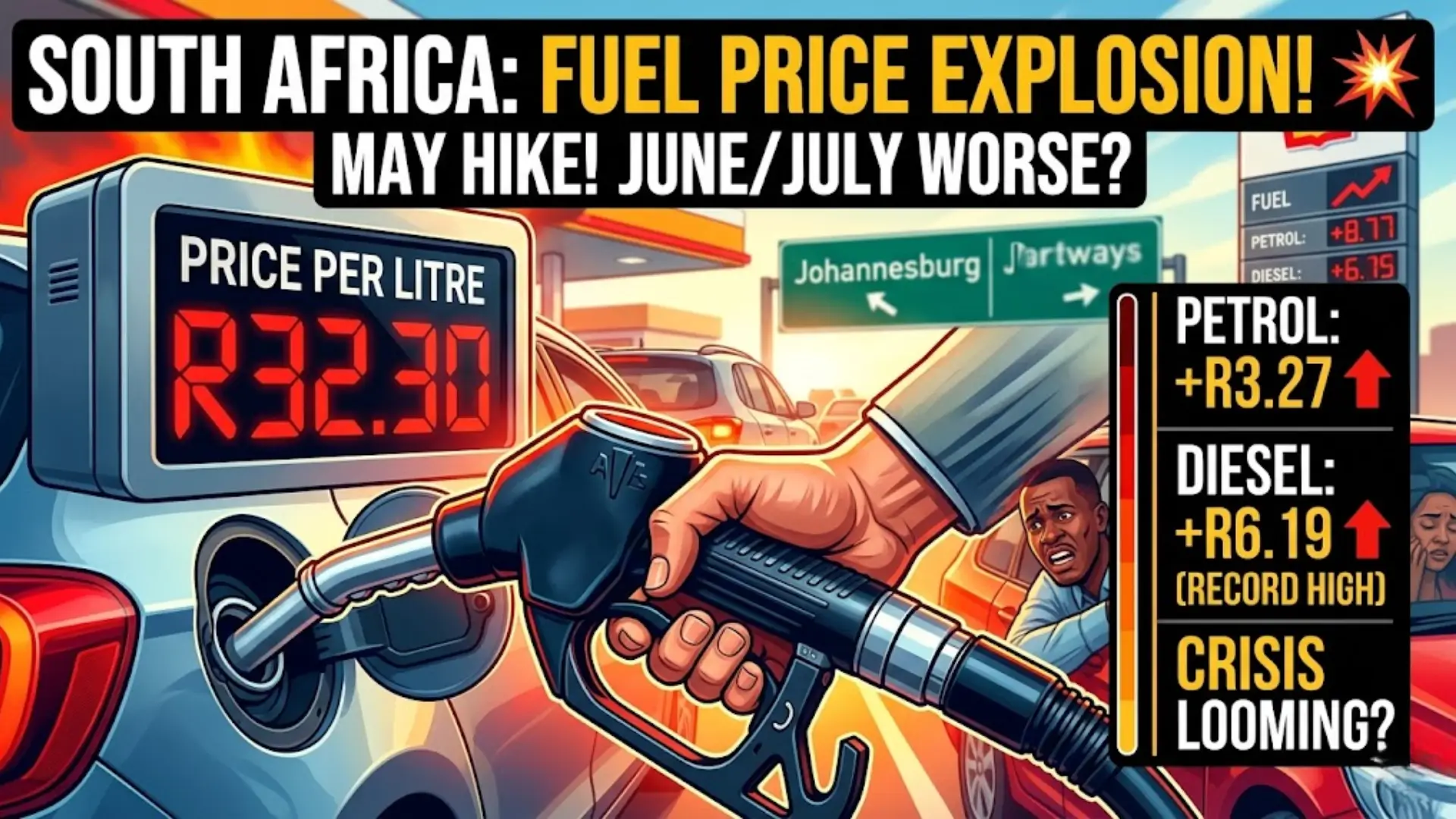
The Department of Mineral and Petroleum Resources confirmed that petrol prices increased by R3.27 per litre, while diesel surged by R6.19 per litre. This jump is significantly higher than earlier projections, which had estimated smaller increases.
Key highlights of the May increase:
- Petrol (both grades): +R3.27 per litre
- Diesel: +R6.19 per litre
- Additional cost driven by the Slate Levy
- Minimal impact from currency fluctuations
These increases reflect not just market trends but also adjustments to recover past under-recoveries in fuel pricing.
You can also read: Nsfas Under Administration Buti Manamela
Understanding the Role of the Slate Levy
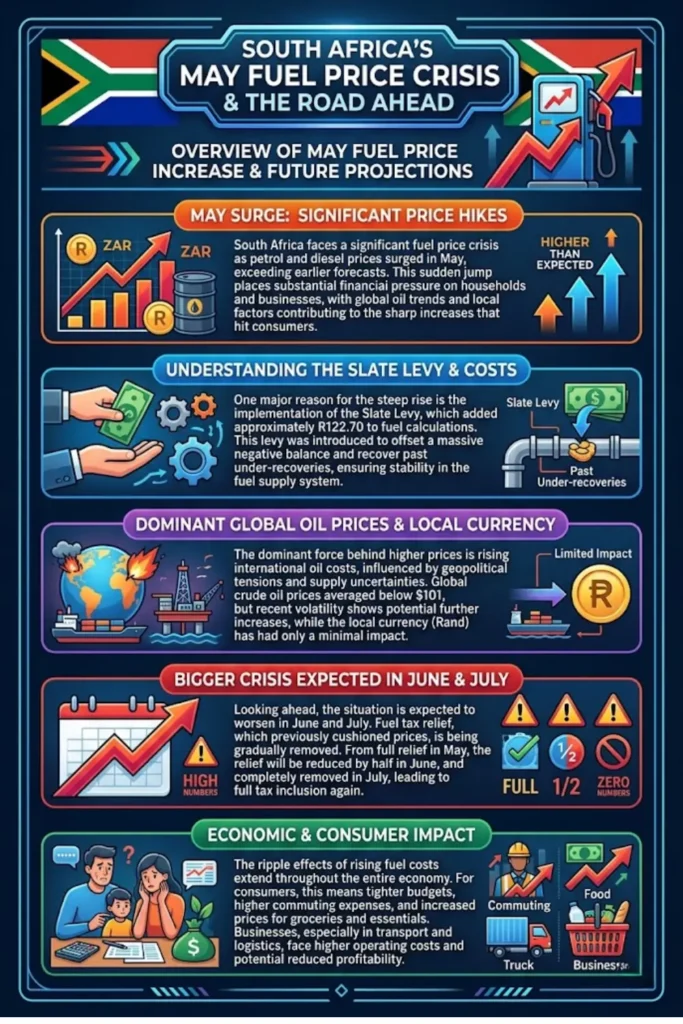
One of the biggest contributors to the unexpected price jump is the implementation of the Slate Levy. This mechanism is used to balance out differences between actual fuel prices and regulated prices over time.
The government applies this levy when fuel companies experience losses due to price mismatches. In this case, a significant negative balance had built up, requiring recovery through higher fuel prices.
Key facts about the Slate Levy:
- Added approximately R122.70 to fuel pricing calculations
- Introduced to offset a negative balance of R14.17 billion
- Applied equally to petrol and diesel
- Ensures stability in the fuel supply system
While necessary for the industry, the levy adds immediate pressure on consumers already dealing with rising living costs.
Current Fuel Prices Across South Africa
Following the May adjustment, fuel prices have reached some of the highest levels seen in recent years. Diesel, in particular, has hit a new record high.
Below is a summary of the updated fuel prices:
| Fuel Type | Coastal Price (R) | Inland Price (R) |
|---|---|---|
| 95 Unleaded Petrol | 25.80 | 26.33 |
| 93 Unleaded Petrol | — | 26.52 |
| 50ppm Diesel | 31.54 | 32.30 |
In addition to these prices, retail margins add approximately R2.50 to R3 per litre depending on the service station.
Although petrol prices remain slightly below the record highs seen in mid-2022, diesel has now surpassed previous records, creating new challenges for transport and logistics sectors.
Global Oil Prices Driving the Increase
The main driver behind the May fuel hike is the rise in international oil prices. Global crude oil markets have seen increased volatility, largely due to geopolitical tensions.
Brent crude oil prices averaged below $101 per barrel during the review period but have recently surged much higher.
Factors influencing global oil prices:
- Ongoing geopolitical tensions in the Middle East
- Stalled peace talks between major oil-producing nations
- Supply uncertainties in global markets
- Increased demand in recovering economies
In the past week alone, oil prices have fluctuated between $113 and $126 per barrel, signaling potential further increases in the coming months.
Limited Impact of the South African Rand
Interestingly, the local currency has played a minimal role in the latest price adjustments. Typically, a weaker rand can significantly increase fuel costs, but this time its impact has been relatively small.
Currency-related insights:
- Rand impact estimated at only 3 to 5 cents per litre
- Global oil prices remain the dominant factor
- Stability in the currency has slightly cushioned the increase
This indicates that even a strong or stable rand may not prevent future price hikes if global oil prices continue to rise.
You can also read: SASSA May 2026 Disability Grant Status
Bigger Fuel Price Crisis Expected in June and July
While May’s increase is already steep, the outlook for June and July is even more concerning. Several factors are expected to push fuel prices higher in the coming months.
One major issue is the gradual removal of the fuel tax relief introduced earlier to ease financial pressure on consumers.
Upcoming changes to fuel tax relief:
- May: Full relief remains in place
- June: Relief reduced by half
- July: Relief completely removed
This means consumers will soon pay the full fuel levy again, significantly increasing pump prices.
Impact of Fuel Tax Adjustments
The removal of fuel tax relief will directly affect the final price consumers pay. These taxes form a large portion of fuel costs in South Africa.
Fuel levy structure (from July onwards):
- Petrol levy: R4.10 per litre
- Diesel levy: R3.93 per litre
Expected effects:
- Immediate increase in fuel prices
- Higher transportation costs
- Increased inflation across goods and services
As fuel costs rise, businesses often pass these expenses on to consumers, leading to higher prices for everyday essentials.
Economic and Consumer Impact
Rising fuel prices affect nearly every aspect of the economy. From transportation to food production, higher fuel costs ripple through multiple sectors.
For households, this means tighter budgets and reduced disposable income. For businesses, especially those reliant on logistics, the pressure is even greater.
Key impacts on consumers:
- Increased commuting costs
- Higher food prices due to transport expenses
- Rising utility and service costs
Key impacts on businesses:
- Increased operating costs
- Reduced profit margins
- Potential price increases for goods and services
These combined effects can slow economic growth and increase financial stress across the country.
What Consumers Can Expect Moving Forward
Looking ahead, the fuel price situation remains uncertain but concerning. If global oil prices continue to rise and tax relief measures are fully withdrawn, consumers may face even higher costs.
Possible future trends:
- Continued fuel price increases in June and July
- Greater dependence on global oil market stability
- Increased pressure on government to intervene
While some relief could come if global conditions improve, current signals suggest that prices may remain elevated in the near term.
You can also read: E Life Certification Self Service Portal
Conclusion
The May fuel price increase has already placed a heavy burden on South Africans, but the situation may worsen in the coming months. Driven largely by global oil prices and local tax adjustments, the cost of fuel is expected to remain a major concern.
Understanding the factors behind these increases can help consumers and businesses better prepare for what lies ahead. With June and July approaching, careful planning and awareness will be essential in managing the impact of rising fuel costs.