R3 Million Primary Residence Exclusion Check Practical Impact on Sellers

South African homeowners have received a notable tax relief opportunity with the increase in the Capital Gains Tax (CGT) exemption on primary residences. The exemption has been raised from R2 million to R3 million, allowing sellers to keep more of their profit when disposing of their homes. This change was introduced in the 2026 budget and is expected to ease the financial burden on many property owners.
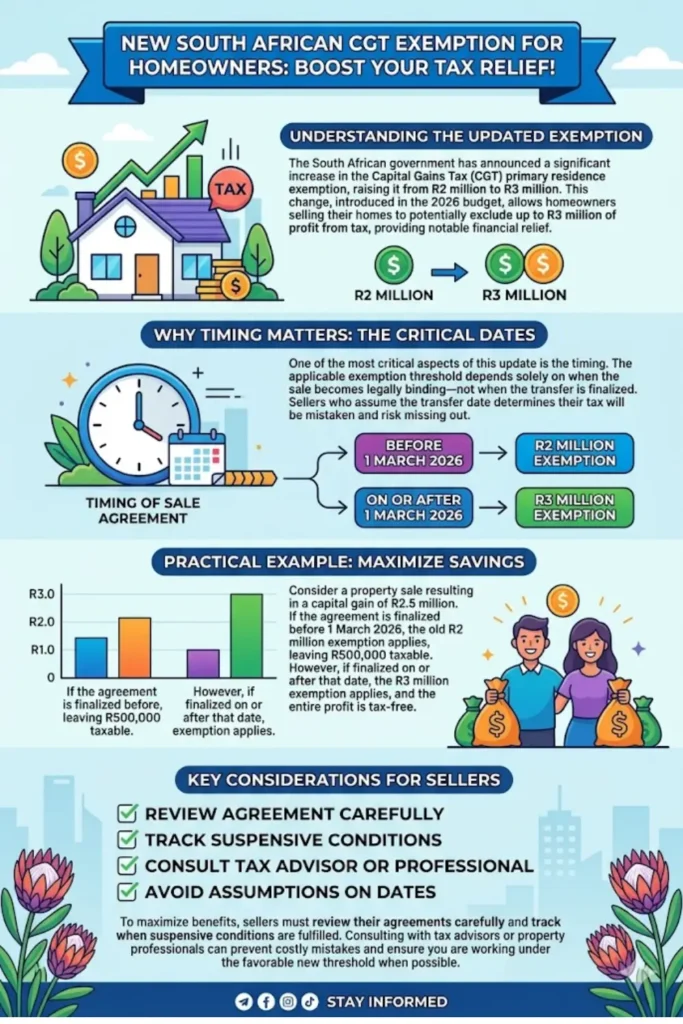
However, while the higher exemption sounds beneficial, not every seller will automatically qualify. The rules around timing and legal agreements play a critical role in determining whether you benefit from the old or new threshold. Understanding these details is essential to avoid missing out on potential savings.
You can also read: SRD Sassa E-life Certification Portal
Understanding the New CGT Exemption Rule
The updated CGT rule increases the tax-free portion of profit made from selling a primary residence. This means that homeowners can exclude up to R3 million of capital gains before tax is applied.
This change can significantly reduce the taxable amount, especially for properties that have appreciated over time. For high-value homes, the difference can be substantial and directly impact net proceeds from the sale.
- Previous exemption: R2 million
- New exemption: R3 million
- Potential additional tax-free gain: R1 million
- Maximum estimated tax saving: up to R180,000
This adjustment reflects an effort to align tax policies with rising property values and inflation, making it more relevant for modern homeowners.
Why Timing Matters More Than Ever
One of the most critical aspects of this tax break is timing. The applicable exemption depends on when the sale becomes legally binding—not when the property transfer is completed or when payment is received.
This distinction can create confusion, especially in property transactions that often take months to finalize. Many sellers mistakenly assume that the transfer date determines tax treatment, which is not the case.
- Agreements finalized before 1 March 2026 → R2 million exemption applies
- Agreements finalized on or after 1 March 2026 → R3 million exemption applies
Because of this rule, even a small delay or early signing can result in a significant difference in tax liability.
What Determines the “Date of Disposal”?
In property law, the “date of disposal” is a key concept. It refers to the moment when the sale agreement becomes unconditional and legally enforceable.
This typically happens when all suspensive conditions in the contract are fulfilled. A common example is when a buyer secures mortgage approval from a bank.
- Signing the agreement alone is not enough
- All conditions must be satisfied
- The contract must be fully binding
Understanding this definition is crucial because it directly determines which CGT exemption applies to your sale.
You can also read: NSFAS Releases R621m Allowances
Practical Example: How the Change Affects Sellers
To better understand the impact, consider a property sale that results in a capital gain of R2.5 million.
| Scenario | CGT Exemption | Taxable Amount |
|---|---|---|
| Agreement before March 1, 2026 | R2,000,000 | R500,000 |
| Agreement on/after March 1, 2026 | R3,000,000 | R0 |
In this example, a seller could completely avoid paying tax if the timing qualifies under the new exemption. This highlights how even a small difference in timing can lead to major financial outcomes.
Key Considerations for Homeowners
Homeowners planning to sell should pay close attention to the legal and procedural details of their transactions. Proper planning can help maximize the benefits of the new exemption.
- Review the terms of your sale agreement carefully
- Track when suspensive conditions are fulfilled
- Consult with a tax advisor or property professional
- Avoid assumptions based on transfer or payment dates
Being proactive can help ensure you do not unintentionally fall under the old exemption rules.
Awareness Gap Among Sellers and Agents
Despite the importance of this change, many sellers—and even some real estate agents—may not be fully aware of the updated CGT exemption. This is partly because the change was not widely highlighted in general tax updates.
This lack of awareness can lead to missed opportunities. Sellers might finalize agreements too early without realizing the financial implications.
- Some agents may overlook the timing rule
- Sellers may focus only on sale price, not tax impact
- Delays or rushed decisions can affect eligibility
Staying informed and asking the right questions can make a meaningful difference in your final financial outcome.
You can also read: SRD Application ID Information
Conclusion
The increase in the CGT exemption to R3 million offers real financial relief for South African homeowners. However, the benefit is not automatic it depends entirely on when the sale becomes legally binding.
A difference of just a few days in contract timing could mean losing out on significant tax savings. That’s why understanding the rules and planning your sale carefully is more important than ever. By paying attention to the legal details and seeking proper guidance, homeowners can make the most of this tax break and avoid costly mistakes.