How to Check South Africa September Petrol Price

South African motorists can check the September petrol price through official fuel-price announcements, government updates and reliable daily fuel-recovery information. The final price is usually confirmed before the new monthly fuel prices take effect, while recovery data can provide an early indication of whether petrol and diesel prices may increase or decrease.
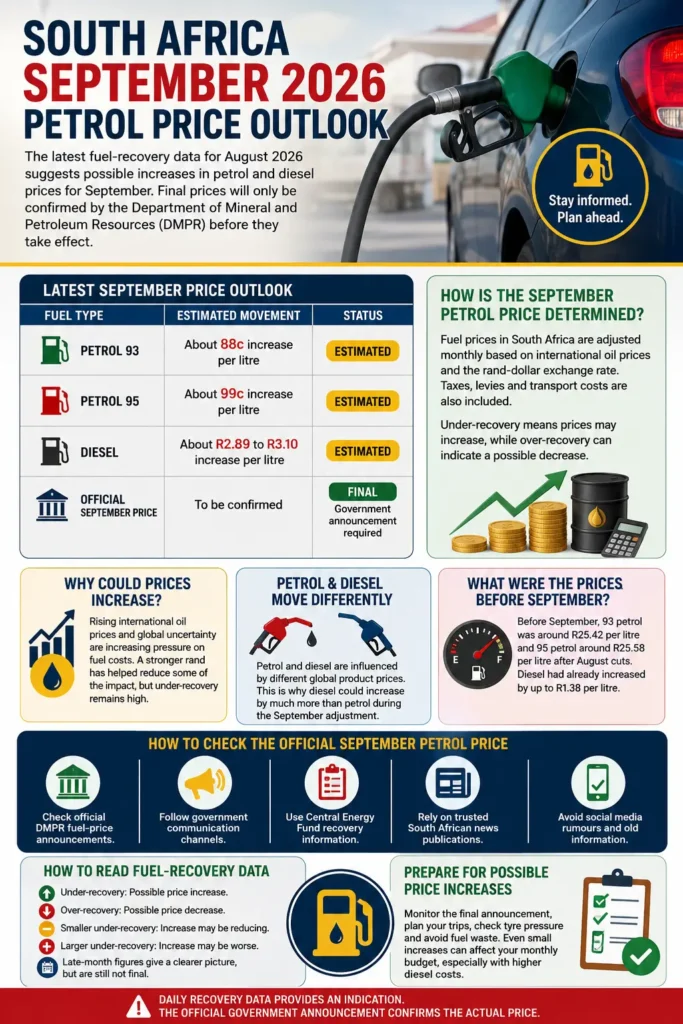
According to the latest fuel-recovery data for August 2026, petrol and diesel prices were pointing towards possible increases in September. However, these figures were still estimates at the time of reporting, and motorists should wait for the official announcement from the Department of Mineral and Petroleum Resources (DMPR) before treating any expected increase as final.
How Is the South Africa September Petrol Price Determined?
South Africa’s fuel prices are adjusted monthly based mainly on international petroleum prices and the rand-dollar exchange rate. The fuel-price calculation also includes other regulated components, such as taxes, levies and transport-related costs. This means the price of petrol can change even when local drivers have not seen an immediate change in international oil prices.
You can also read: Postbank Sassa Gold Card Deadline
During the month, authorities monitor the difference between the calculated fuel cost and the current pump price. An under-recovery generally means current fuel prices are lower than the calculated level, which can indicate a possible price increase. An over-recovery can point towards a possible price decrease.
Latest September Petrol Price Outlook
The latest August 2026 fuel-recovery figures indicated that September could bring higher fuel prices. The estimated under-recovery was approximately 88 cents per litre for 93 petrol and 99 cents per litre for 95 petrol, while diesel was showing potentially much larger increases of roughly R2.89 to R3.10 per litre.
These figures are not the final September fuel prices. Recovery data can change before the monthly review period closes because international oil prices and the rand-dollar exchange rate can move quickly. The final figures should therefore only be confirmed after the official government announcement.
| Fuel Type | Latest Estimated September Movement | Status |
|---|---|---|
| Petrol 93 | About 88c increase per litre | Estimated |
| Petrol 95 | About 99c increase per litre | Estimated |
| Diesel | About R2.89 to R3.10 increase per litre | Estimated |
| Official September Price | To be confirmed | Final government announcement required |
Where to Check the Official September Petrol Price
The safest way to check the final South Africa September petrol price is to use official government information. The Department of Mineral and Petroleum Resources publishes the approved monthly fuel-price adjustments after the official calculation process is completed.
You can also follow trusted South African news sources for early recovery updates, but always separate an estimated fuel-price outlook from the final official price. News reports can help motorists prepare, while the government announcement provides the confirmed amount that filling stations will implement.
Check These Sources for Confirmation
- Official Department of Mineral and Petroleum Resources fuel-price announcements
- Government communication channels and official statements
- Central Energy Fund fuel-recovery information
- Reliable South African financial and news publications
Do not rely only on social-media posts, screenshots or old articles, as these may contain estimates or prices from a previous month.
How to Check Daily Fuel-Recovery Estimates
Fuel-recovery data can help you understand what may happen to petrol prices before the official announcement. These estimates are especially useful during the final days of the monthly fuel-price review period, but they should not be confused with confirmed prices.
When checking recovery data, first look at whether petrol or diesel is showing an under-recovery or over-recovery. Then check the date of the figures, because an estimate from earlier in the month may no longer reflect the latest oil price or exchange-rate movement.
A Simple Way to Read Recovery Figures
- Under-recovery: A possible fuel-price increase is building.
- Over-recovery: A possible fuel-price decrease is building.
- Smaller under-recovery: The expected increase may be reducing.
- Larger under-recovery: The expected increase may be getting worse.
- Late-month figures: Usually provide a clearer indication, but are still not final until officially announced.
Always check the date before sharing or using a recovery estimate.
Why Could the September Petrol Price Increase?
International oil prices were a major reason behind the worsening September outlook. Oil prices had moved lower earlier in August as tensions connected to the US-Iran situation eased, but prices later climbed again following concerns about further sanctions against Iran.
You can also read: SASSA Gold Card Deadline 31 August 2026
The stronger rand provided some relief by reducing part of the expected fuel-price pressure. At around R16 to the US dollar, the stronger currency was reportedly helping offset approximately 15 cents per litre from the under-recovery. Without rand support, the estimated increases could have been even higher.
Petrol and Diesel Prices Can Move Differently
A common mistake is assuming petrol and diesel always increase or decrease by the same amount. They are affected by different international product prices, so the monthly adjustment for diesel can be much larger or smaller than the adjustment for petrol.
For September 2026, the latest estimates showed this difference clearly. Petrol was pointing towards increases of less than R1 per litre, while diesel was facing a potential increase of close to R3 per litre or more depending on the grade.
What Were the Current Petrol Prices Before September?
Before the possible September adjustment, inland motorists were paying around R25.42 per litre for 93 petrol and R25.58 per litre for 95 petrol after both grades decreased by 52 cents in August. Diesel, however, had already increased by as much as R1.38 per litre during the August adjustment.
If the September estimates are confirmed close to the reported levels, much of the previous petrol-price relief could be reversed. The exact price you pay can also vary depending on whether you are in an inland or coastal pricing zone.
Common Mistakes When Checking the September Petrol Price
Motorists often see a headline about an expected fuel increase and assume it is already the final official price. This can lead to confusion, especially when recovery figures change during the last few days of the review period.
To avoid misinformation, keep these points in mind:
- Do not treat early-month recovery figures as final prices.
- Check whether a report says estimated, expected or official.
- Confirm the publication date of the information.
- Check whether the price is for petrol 93, petrol 95 or diesel.
- Remember that inland and coastal prices can differ.
- Wait for the official monthly announcement before making major fuel-budget decisions.
The most important rule is simple: daily recovery data provides an indication, while the official government announcement confirms the actual price.
How to Prepare for a Possible Petrol Price Increase
If you regularly drive to work, school or other important destinations, checking the fuel-price outlook can help you plan your monthly budget. Even a 50-cent or R1 increase per litre can have a noticeable effect on drivers who travel long distances or fill large vehicles.
You can prepare by monitoring the final announcement, planning essential trips, checking tyre pressure and avoiding unnecessary fuel waste. For businesses and families that depend heavily on transport, diesel increases can also raise delivery and travel costs.
Best Way to Stay Updated on South Africa Fuel Prices
The best approach is to check fuel news near the end of each monthly review period and then verify the final price through an official announcement. This gives you both an early warning and a confirmed figure.
For the September 2026 petrol price, the latest recovery figures suggest that motorists should prepare for possible increases, but the final adjustment remains dependent on market movements and the official calculation before the new prices take effect.
Frequently Asked Questions
Is the September petrol price increase final?
No. The latest figures are fuel-recovery estimates and not the final official September fuel prices. The confirmed adjustment must come from the Department of Mineral and Petroleum Resources.
How much could petrol increase in September?
Based on the latest August 2026 recovery estimates provided, 93 petrol was pointing to an increase of about 88 cents per litre, while 95 petrol was pointing to about 99 cents per litre. These amounts could still change before the final announcement.
Why is diesel expected to increase more than petrol?
Petrol and diesel are priced using different international product benchmarks. This means changes in global markets can affect diesel more heavily than petrol during a particular monthly fuel-price cycle.
When should I check the final September petrol price?
Check the official fuel-price announcement when it is released before the new monthly prices take effect. Late-month recovery figures are useful for estimates, but the government announcement is the final confirmation.
Conclusion
Checking the South Africa September petrol price is easy when you know the difference between daily recovery estimates and the official monthly fuel-price announcement. The latest August 2026 data points towards higher petrol and diesel prices, with diesel facing particularly strong upward pressure.
You can also read: NSFAS Student DEBT
For accurate information, monitor reliable fuel-recovery updates but always wait for the official DMPR announcement before considering a September petrol price increase final. This is the best way to avoid outdated information and plan your fuel budget with confidence.