NSFAS Student DEBT: Proposal Calls for Graduate Salary Deductions
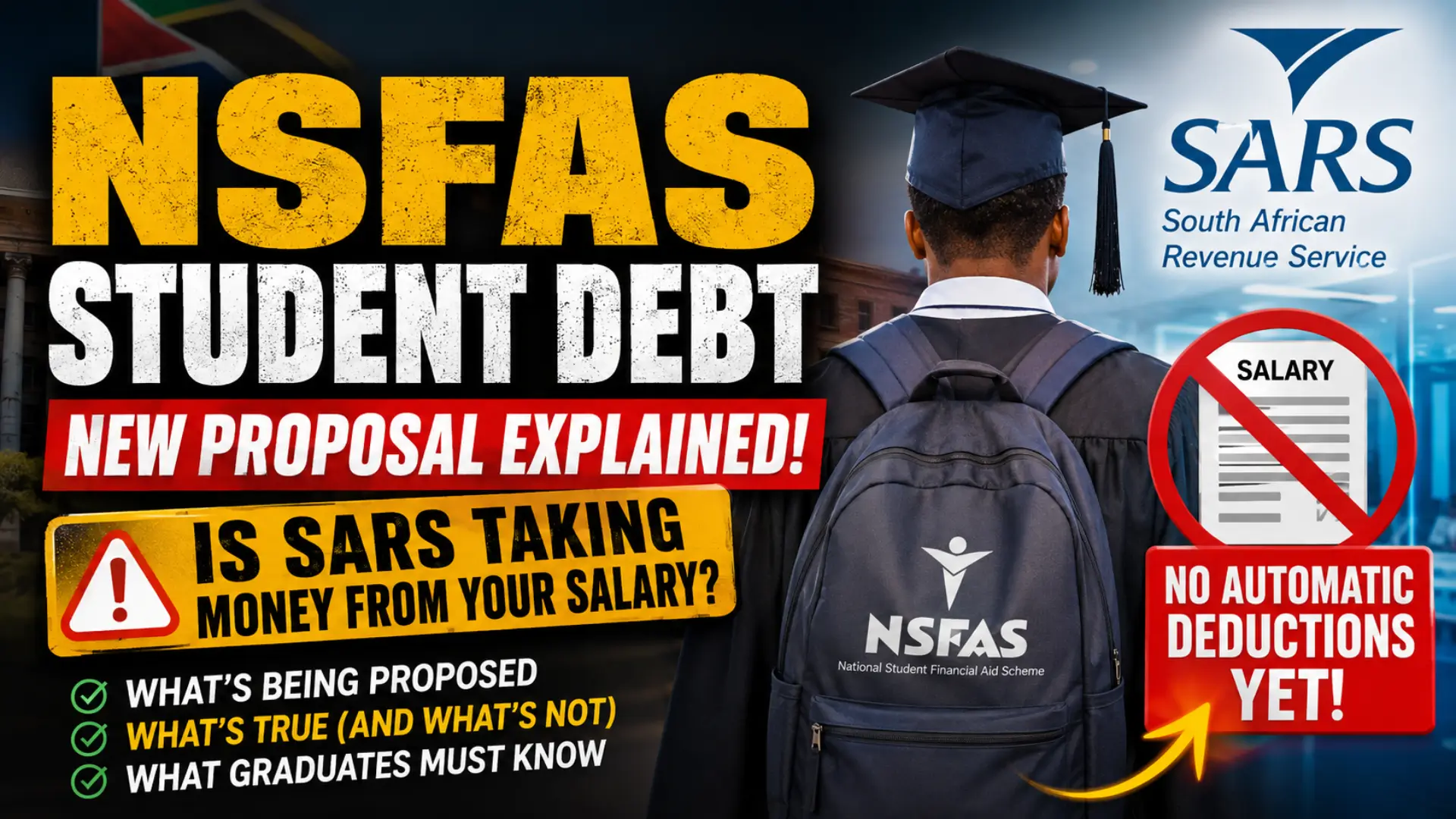
NSFAS student debt has become a major issue in South Africa as policymakers look for better ways to recover money from graduates while keeping financial aid available for future students. One proposal being discussed is the use of existing income and employment information to identify graduates who are earning an income and recover repayments according to their ability to pay.
However, an important distinction must be made: SARS is not currently automatically deducting NSFAS student loan repayments from graduates’ salaries as part of a newly implemented national system. The idea of using government income data or salary deductions is part of the broader debate about improving NSFAS debt recovery. Graduates should therefore not assume that a new automatic SARS deduction has already started.
NSFAS Student Debt Proposal Explained
The proposal comes against the background of a much larger student debt problem across South Africa’s post-school education sector. Parliament’s Portfolio Committee on Higher Education reported in May 2026 that outstanding student debt had reached about R59 billion, with approximately R29 billion linked to NSFAS-funded students.
You can also read: SRD R350 Status Check if Approved
The debate is essentially about creating a repayment system that is more effective without placing graduates who are unemployed or earning low salaries under unnecessary financial pressure. If graduates who can afford repayments contribute consistently, more money could potentially return to the student funding system and help support future students.
Why Is Graduate Repayment Being Discussed?
NSFAS has expanded significantly as more South Africans have relied on government financial assistance to access universities and TVET colleges. At the same time, the growing cost of higher education, accommodation and other student expenses has placed additional pressure on the funding system.
The student debt problem is not limited to NSFAS alone. Parliament has described it as a sector-wide challenge affecting students, universities and the broader sustainability of post-school education.
Several factors explain why repayment mechanisms are receiving greater attention:
- Large outstanding student debt: Billions of rand remain unpaid across the post-school sector.
- Pressure on NSFAS finances: Better recovery could reduce pressure on public funding.
- Different graduate incomes: Some graduates earn high salaries while others struggle to find employment.
- Difficulty tracking graduates: Contact and employment information can change after students leave institutions.
- Need to fund future students: Recovered loan money can strengthen the long-term sustainability of student funding.
The goal is therefore not simply to collect as much money as possible. A workable system would need to balance debt recovery, graduate affordability and continued access to higher education.
How Could Income-Based NSFAS Repayment Work?
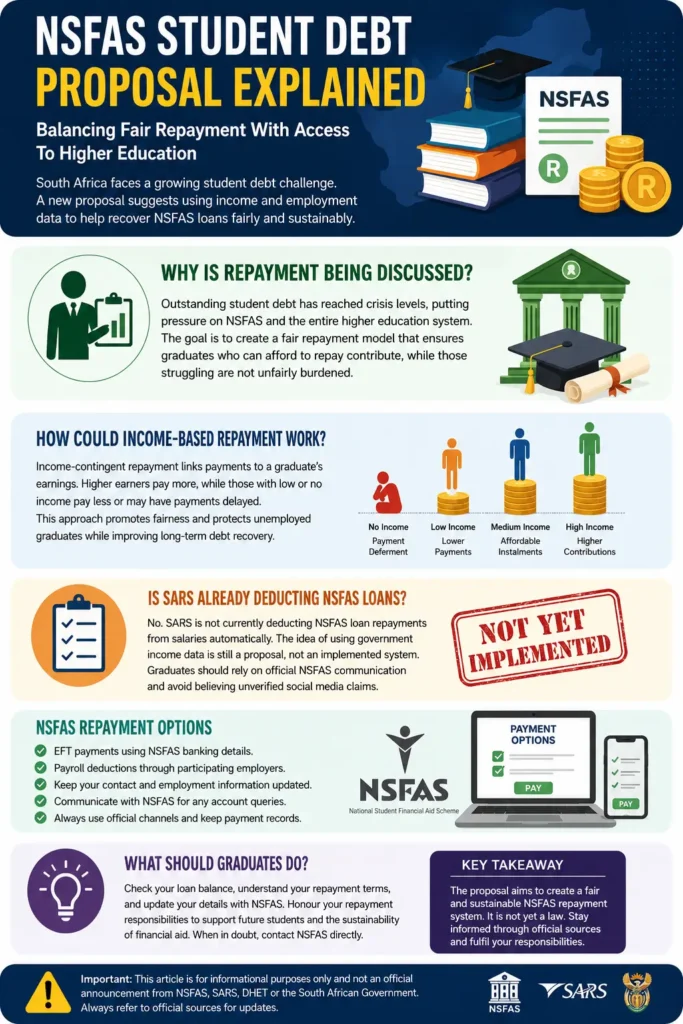
An income-contingent repayment model links the amount a graduate pays to their income. Someone earning a relatively high salary could make larger repayments, while a graduate earning little or nothing could have a lower payment or potentially have repayment delayed until their circumstances improve.
This approach is particularly important in South Africa because obtaining a qualification does not automatically mean securing a well-paid job. A repayment system that ignores income could place unemployed graduates and low-income workers under the same financial burden as graduates with strong earnings.
| Graduate situation | Possible repayment approach |
|---|---|
| No employment | Repayment could be deferred under applicable rules |
| Very low income | Lower repayment amount |
| Moderate income | Affordable regular instalments |
| Higher income | Higher repayment contribution |
| Stable employment | Regular monthly repayment arrangement |
The exact income thresholds, deduction percentages and enforcement rules would need to be established through the appropriate legal and administrative process before any new mandatory system could operate.
Is SARS Already Deducting NSFAS Loan Repayments?
No. Graduates should not interpret the current proposal as confirmation that SARS has started automatically deducting NSFAS loan repayments from salaries. The discussion about potentially using government income and employment data is different from an implemented national salary-deduction programme.
Current SARS information on employee tax and payroll administration does not establish a new automatic NSFAS loan deduction system. Therefore, social media posts claiming that every NSFAS graduate is now having money removed from their salary by SARS should be treated cautiously unless supported by an official announcement.
This distinction matters because a proposal, a policy discussion and an implemented repayment system are not the same thing. Any mandatory deduction mechanism would require the relevant legal, administrative and privacy arrangements to be clearly established.
NSFAS Already Allows Payroll Deductions
NSFAS already has a payroll or payslip deduction option for certain borrowers who have entered repayment. According to NSFAS, certain employers can deduct a borrower’s monthly NSFAS loan repayment directly from their payslip and transfer the money to NSFAS.
That existing arrangement should not be confused with the proposed idea of automatically identifying graduates through government income records and enforcing deductions nationally. Under the current NSFAS repayment information, borrowers can also pay through methods such as EFT.
Current NSFAS repayment options include:
- EFT payments using the payment details provided by NSFAS.
- Payroll or payslip deductions where the relevant employer arrangement is available.
- Direct engagement with NSFAS when a borrower needs clarification about their repayment account.
- Updating employment and contact information so that NSFAS can maintain accurate borrower records.
The safest approach is to check the repayment information directly through NSFAS rather than relying on social media posts about supposed salary deductions.
The Growing NSFAS Student Debt Problem
The scale of student debt explains why repayment reform has become such an important issue. Parliament reported in May 2026 that total outstanding debt across the post-school education system stood at around R59 billion, while NSFAS-funded students accounted for approximately R29 billion of that figure.
Parliament has also highlighted problems involving reconciliation between NSFAS and higher education institutions. These administrative issues matter because student debt does not always arise from a graduate simply refusing to pay. Accommodation charges, funding reconciliation problems and other institutional issues can contribute to outstanding balances.
Why Income-Contingent Repayment Could Help
The strongest argument for income-based repayment is that graduates do not leave university or college with identical financial circumstances. One person may immediately secure a professional position, while another may spend months or years searching for work.
A repayment system linked to income attempts to recognise this difference. Instead of demanding the same amount from every graduate, repayments can theoretically rise or fall with the borrower’s ability to pay.
Potential advantages include:
- More affordable repayments for graduates with lower incomes.
- Higher recovery from graduates who can comfortably afford to repay.
- Less pressure on unemployed graduates during periods without earnings.
- Better long-term sustainability for student funding.
- More consistent repayment collection compared with relying entirely on voluntary payments.
The major challenge is designing the system fairly. Income thresholds, privacy protections, dispute procedures and safeguards for unemployed or financially distressed graduates would all need careful consideration.
Graduate Unemployment Could Affect Repayments
Any proposal based on graduate salaries must take South Africa’s employment environment seriously. Completing a university or TVET qualification does not guarantee immediate employment, and some graduates may spend considerable time looking for work or may start in relatively low-paying positions.
You can also read: Postbank Sassa Gold Card Deadline
This means an effective repayment model should distinguish between a graduate who is deliberately avoiding repayment despite having sufficient income and a graduate who genuinely cannot afford to pay. Treating both situations identically could create unnecessary hardship.
NSFAS Student Loans vs Bursary Funding
Another important point is that not all NSFAS funding arrangements are identical. Students should check whether their funding was provided as a bursary, a loan or under another applicable funding arrangement because repayment obligations can differ.
The current NSFAS loan guidelines state that loan repayment is linked to employment and income. The guidelines also indicate that a higher annual income can result in higher monthly instalments, while repayment can be delayed until employment is secured.
What the Proposal Could Mean for Graduates
For graduates with outstanding NSFAS student loans, the most important issue is not to panic over headlines suggesting that salaries are already being automatically deducted. The current debate should not be treated as an announcement that every NSFAS debtor will immediately lose part of their salary.
Graduates who already have repayment obligations should nevertheless take those obligations seriously. Ignoring correspondence, failing to update employment information or assuming that a loan will disappear because repayment is difficult can create additional problems later.
Graduates should consider these practical steps:
- Check their current NSFAS loan balance.
- Confirm whether they have entered the repayment stage.
- Keep contact and employment information updated.
- Review the repayment arrangement available to them.
- Keep records of payments and correspondence.
- Contact NSFAS if they believe their account is incorrect.
- Avoid paying through unofficial channels or relying on social media payment instructions.
What Current NSFAS Students Need to Know
Current NSFAS-funded students do not need to assume that their salaries will automatically be deducted because of the repayment proposal. The discussion concerns how repayment could be improved in the future and how outstanding debt could be recovered more effectively.
At the same time, students should understand the type of funding they receive and the conditions attached to it. Keeping accurate personal information with NSFAS can also make it easier to manage future communication about funding or repayment.
Recent parliamentary discussions also show that NSFAS is facing wider governance and administrative challenges. In August 2026, Parliament’s Portfolio Committee raised concerns following a Public Protector report concerning approximately R5.1 billion in improper student funding involving about 40,000 students across 76 higher education institutions.
What Graduates With NSFAS Debt Should Do
Graduates who already have outstanding NSFAS loans should not wait for a possible future policy change before checking their accounts. Existing repayment arrangements remain important, and NSFAS currently provides official repayment information and payment methods.
If a graduate has recently found employment, they should make sure NSFAS has the relevant information required under their loan agreement. The NSFAS loan guidelines state that borrowers are responsible for notifying NSFAS about employment and that repayments are linked to income and employment under the applicable loan terms.
A sensible repayment checklist is:
- Check: Confirm the outstanding NSFAS loan amount.
- Update: Make sure contact and employment details are accurate.
- Understand: Read the repayment terms applicable to your loan.
- Pay: Use an official NSFAS payment method.
- Record: Keep proof of every payment.
- Question: Challenge incorrect balances or information through the appropriate NSFAS process.
These steps are useful regardless of whether a broader national salary-deduction system is eventually introduced.
Common Mistakes to Avoid
The biggest mistake is believing an online headline without checking whether it describes an implemented policy or a proposal. Claims that “SARS has started taking NSFAS money from every graduate’s salary” should not be accepted without an official announcement from the relevant authorities.
Another mistake is confusing NSFAS’s existing payroll deduction option with an automatic SARS deduction. NSFAS confirms that certain employers can facilitate payroll deductions, but this is not evidence that SARS is currently operating a universal NSFAS salary-deduction programme.
Graduates should avoid:
- Believing unverified WhatsApp or Facebook claims.
- Assuming every NSFAS beneficiary has a loan.
- Ignoring an existing repayment obligation.
- Sending money to unofficial payment accounts.
- Assuming unemployment permanently cancels a loan.
- Ignoring incorrect NSFAS account information.
- Treating a proposal as if it were already law.
What Happens Next With NSFAS Debt Recovery?
The debate is likely to continue as South Africa tries to make NSFAS financially sustainable while protecting students who genuinely need assistance. Any new repayment mechanism would need to address more than collection alone; it would also need reliable records, clear income thresholds, legal authority, data protection and accessible dispute mechanisms.
You can also read: SASSA Gold Card Deadline 31 August 2026
The broader financial pressure on NSFAS makes the issue increasingly important. Parliament has described the student debt crisis as a serious threat to the sustainability of the higher education system and has called for stronger management and reconciliation processes.
Key point for graduates
No new universal SARS salary deduction for NSFAS loans should be assumed to be in operation simply because the proposal is being discussed. Graduates should continue following the repayment terms that apply to their individual NSFAS loans and rely on official NSFAS communications for changes.
Frequently Asked Questions About NSFAS Student Debt
Is SARS currently deducting NSFAS repayments from salaries?
No automatic national SARS deduction system should be assumed to be in place based on the current information. The idea of using income and employment data to improve NSFAS debt recovery is part of the wider policy discussion.
Does NSFAS already offer salary deductions?
Yes. NSFAS states that certain employers can deduct monthly NSFAS loan repayments directly from an employee’s payslip and pay the amount to NSFAS.
Will unemployed graduates have to repay immediately?
The applicable NSFAS loan terms matter. The current NSFAS loan guidelines state that repayment can be delayed until employment is secured and that repayment amounts are linked to income.
How much NSFAS student debt is outstanding?
Parliament reported in May 2026 that total outstanding debt across the post-school education sector was about R59 billion, with around R29 billion attributed to NSFAS-funded students.
Does every NSFAS beneficiary have to repay money?
Not necessarily. Students must establish what type of NSFAS funding they received and whether repayment conditions apply to their specific funding arrangement.
Final Takeaway
The debate over NSFAS student debt and proposed graduate salary deductions reflects a much bigger challenge: South Africa needs to recover money from graduates who can afford to repay while protecting graduates who are unemployed or earning too little to manage significant instalments.
For now, the most important distinction is between what is being proposed and what is already implemented. There is no basis for treating the current discussion as proof that SARS has begun automatically deducting NSFAS repayments from every graduate’s salary. NSFAS does, however, already provide repayment mechanisms, including payroll deductions through certain employers.
Important: This article is for informational purposes and does not constitute an official announcement from NSFAS, SARS, DHET or the South African government. Proposed repayment reforms should not be presented as implemented policy until the relevant authorities formally announce them.
Sources: NSFAS official repayment information; NSFAS Loan Scheme Guidelines; Parliament of South Africa statements on the student debt crisis and NSFAS administration; SARS official tax and payroll guidance.